Cassiopeia
Cassiopeia is a prominent northern constellation named after the vain queen of Greek mythology. Notable for its distinctive “W” asterism formed by five bright stars, it lies along the plane of the Milky Way and contains many deep-sky objects, including the supernova remnant Cassiopeia A and star‑forming regions such as IC 63.
Source: nasa.gov
APODs including "Cassiopeia"
Star Formation in the Pacman Nebula
26/03/2025
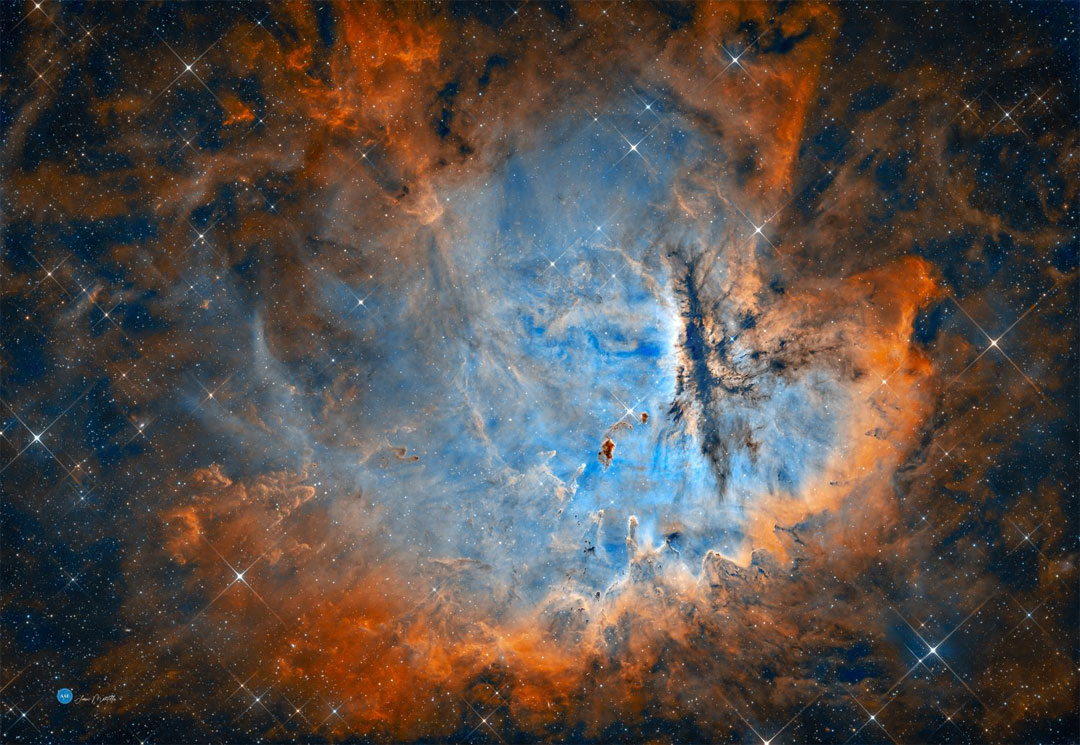
You'd think the Pacman Nebula would be eating stars, but actually it is forming them. Within the nebula, a cluster's young, massive stars are powering the pervasive nebular glow. The eye-catching shapes looming in the featured portrait of NGC 281 are sculpted dusty columns and dense Bok globules seen in silhouette, eroded by intense, energetic winds and radiation from the hot cluster stars. If they survive long enough, the dusty structures could also be sites of future star formation. Playfully called the Pacman Nebula because of its overall shape, NGC 281 is about 10,000 light-years away in the constellation Cassiopeia. This sharp composite image was made through narrow-band filters in Spain in mid 2024. It combines emissions from the nebula's hydrogen and oxygen atoms to synthesize red, green, and blue colors. The scene spans well over 80 light-years at the estimated distance of NGC 281.