Centaurus
Centaurus is a prominent constellation in the southern sky, representing a centaur from Greek mythology. It contains notable celestial objects, including Alpha Centauri, the closest star system to the Sun, and Omega Centauri, the largest globular cluster in the Milky Way.
Source
APODs including "Centaurus"
Seeing Through Galaxies
5 December 1997
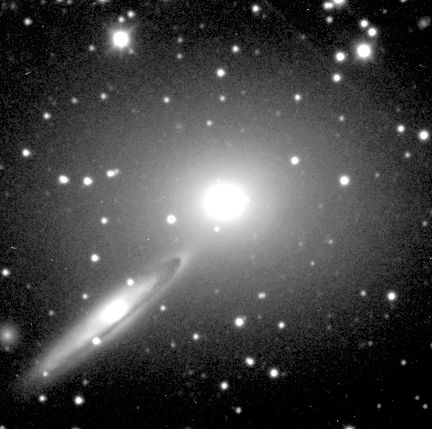
In this dramatic picture, spiral galaxy NGC 5091 appears in the foreground. Tilted nearly edge-on, the dust lanes between its spiral arms are clearly visible. The large elliptical galaxy NGC 5090 lies just beyond it - both are about 100 million light years distant in the southern constellation Centaurus. Can you see through the spiral galaxy? The detailed answer to this question has important implications for determining the nature of dark matter and the measurement of star formation rates. Comparing the overlapping and non-overlapping parts of this and other pairs of galaxies offers a neat way to find the answer.