Comet
A comet is a small Solar System body composed mainly of ice, dust, and organic compounds. As they approach the Sun, cometary ices sublimate, releasing gas and dust that form the glowing coma and distinctive tails—often extending millions of kilometers.
Comets originate from two primary reservoirs: the Kuiper Belt—home to short-period comets with orbits under ~200 years—and the distant Oort Cloud, which sends long-period comets with orbits spanning thousands of years. Occasionally, interstellar objects like ‘Oumuamua pass through our system, appearing comet-like.
They are “dirty snowballs” and among the most primitive remnants of the early Solar System, preserving original ices and organic material from 4.6 billion years ago.
Landmark missions include ESA’s Rosetta—with its lander Philae—which orbited and sampled Comet 67P/Churyumov–Gerasimenko (2014–2016). NASA’s Deep Impact struck Comet Tempel 1 in 2005 to analyze interior composition.
These missions discovered complex organic molecules, including amino-acid precursors, and supported the theory that comets may have delivered water and prebiotic compounds to early Earth.
Looking ahead, ESA–JAXA’s Comet Interceptor (launch planned for 2029) intends to perform a rapid flyby of a dynamically new or interstellar comet, using multiple spacecraft to sample both nucleus and coma environments.
Comets are studied across the electromagnetic spectrum—from radio to gamma rays—using telescopes and spacecraft to understand composition, internal structure, activity, and their roles in planetary formation, the evolution of the solar system, and the origin of life.
Sources
APODs including "Comet"
The McMath-Pierce Solar Observatory
15 March 1996
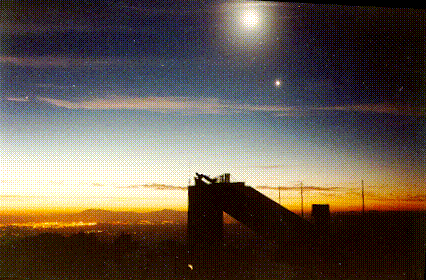
This odd-looking structure silhouetted in the foreground houses the three largest solar telescopes in the world. Located in Kitt Peak, Arizona, the largest telescope inside the McMath-Pierce Facility is 1.6-meters in diameter and contains only mirrors. The telescope contains no windows or lenses because focusing bright sunlight would overheat them. Visible in the background of this sunrise photo are the Moon and Venus. The telescopes are used in many research projects including determining the Sun's structure, researching the cause of the solar corona, monitoring Sun-spots and solar flares, and observing bright planets and comets near the Sun. The telescopes even help monitor the Earth's atmospheric content of ozone and CFCs! Information: The Scale of the Universe Debate in April 1996