Comet
A comet is a small Solar System body composed mainly of ice, dust, and organic compounds. As they approach the Sun, cometary ices sublimate, releasing gas and dust that form the glowing coma and distinctive tails—often extending millions of kilometers.
Comets originate from two primary reservoirs: the Kuiper Belt—home to short-period comets with orbits under ~200 years—and the distant Oort Cloud, which sends long-period comets with orbits spanning thousands of years. Occasionally, interstellar objects like ‘Oumuamua pass through our system, appearing comet-like.
They are “dirty snowballs” and among the most primitive remnants of the early Solar System, preserving original ices and organic material from 4.6 billion years ago.
Landmark missions include ESA’s Rosetta—with its lander Philae—which orbited and sampled Comet 67P/Churyumov–Gerasimenko (2014–2016). NASA’s Deep Impact struck Comet Tempel 1 in 2005 to analyze interior composition.
These missions discovered complex organic molecules, including amino-acid precursors, and supported the theory that comets may have delivered water and prebiotic compounds to early Earth.
Looking ahead, ESA–JAXA’s Comet Interceptor (launch planned for 2029) intends to perform a rapid flyby of a dynamically new or interstellar comet, using multiple spacecraft to sample both nucleus and coma environments.
Comets are studied across the electromagnetic spectrum—from radio to gamma rays—using telescopes and spacecraft to understand composition, internal structure, activity, and their roles in planetary formation, the evolution of the solar system, and the origin of life.
Sources
APODs including "Comet"
Meteor by Moonlight
15 August 2009
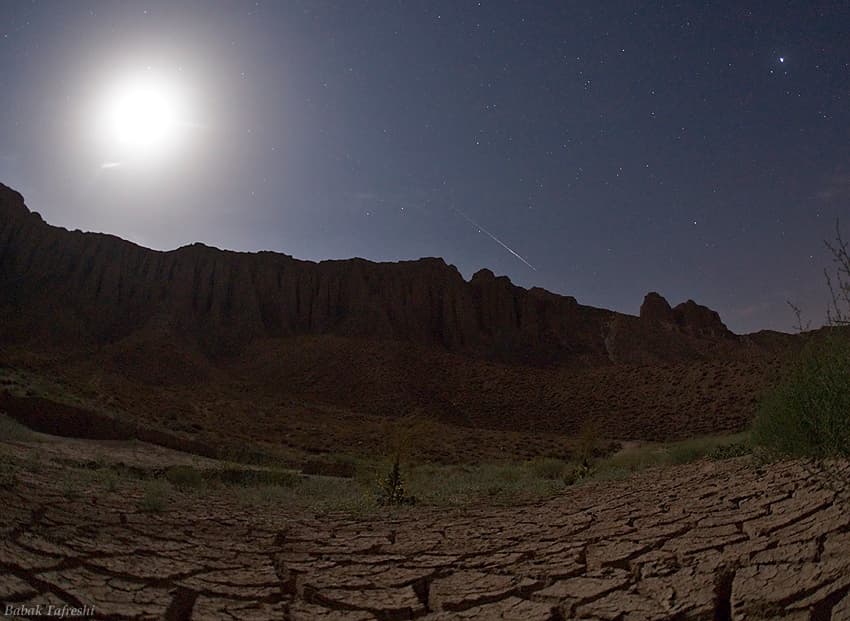
Dark skies are favored for viewing meteor showers. But the annual Perseid Meteor Shower still entertained skygazers around the world this week even though the Moon brightened the night. At its last quarter phase and rising around midnight on August 13, after the shower's anticipated peak, the Moon is seen here above rock formations in the Alborz Mountains near Firouzkooh, Iran. With a dramatic desert landscape in the foreground, a Perseid meteor is streaking through the moonlit sky between the overexposed Moon and bright planet Jupiter at the upper right. A regular celestial event in the northern hemisphere, the Perseid Meteor Shower is caused by planet Earth's yearly passage through the dust stream cast off by comet Swift-Tuttle.