Comet
A comet is a small Solar System body composed mainly of ice, dust, and organic compounds. As they approach the Sun, cometary ices sublimate, releasing gas and dust that form the glowing coma and distinctive tails—often extending millions of kilometers.
Comets originate from two primary reservoirs: the Kuiper Belt—home to short-period comets with orbits under ~200 years—and the distant Oort Cloud, which sends long-period comets with orbits spanning thousands of years. Occasionally, interstellar objects like ‘Oumuamua pass through our system, appearing comet-like.
They are “dirty snowballs” and among the most primitive remnants of the early Solar System, preserving original ices and organic material from 4.6 billion years ago.
Landmark missions include ESA’s Rosetta—with its lander Philae—which orbited and sampled Comet 67P/Churyumov–Gerasimenko (2014–2016). NASA’s Deep Impact struck Comet Tempel 1 in 2005 to analyze interior composition.
These missions discovered complex organic molecules, including amino-acid precursors, and supported the theory that comets may have delivered water and prebiotic compounds to early Earth.
Looking ahead, ESA–JAXA’s Comet Interceptor (launch planned for 2029) intends to perform a rapid flyby of a dynamically new or interstellar comet, using multiple spacecraft to sample both nucleus and coma environments.
Comets are studied across the electromagnetic spectrum—from radio to gamma rays—using telescopes and spacecraft to understand composition, internal structure, activity, and their roles in planetary formation, the evolution of the solar system, and the origin of life.
Sources
APODs including "Comet"
Northern Mercury
1 December 2012
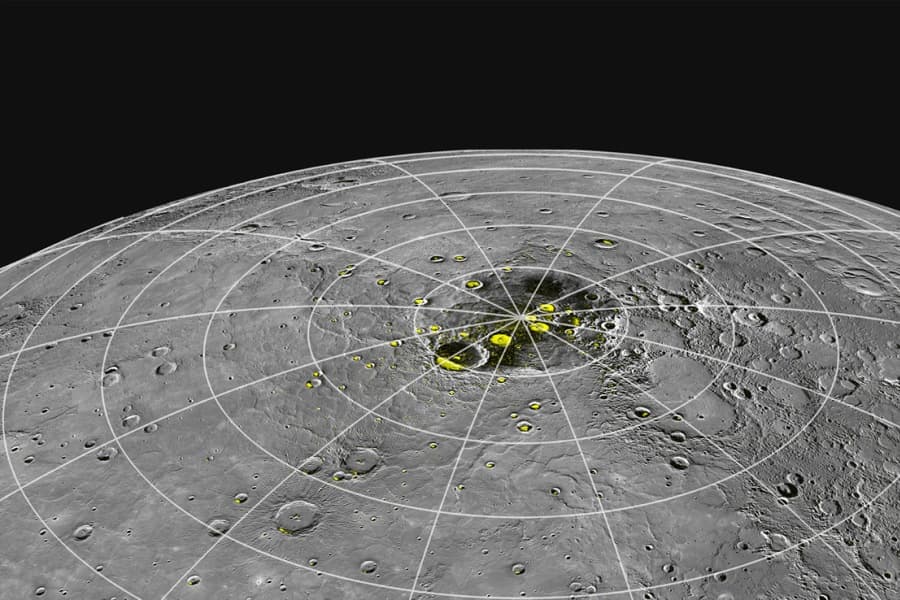
Innermost planet Mercury would probably not be a good location for an interplanetary winter olympics. But new results based on data from the Mercury orbiting MESSENGER spacecraft indicate that it does have substantial water ice in permanently shadowed regions within craters near its north pole. The possibility of ice on Mercury has been entertained for years, inspired by the discovery of radar bright, hence highly reflective, regions near the north pole. Highlighted in yellow in this map based on projected MESSENGER images, radar bright regions are seen to correspond with floors and walls of north polar impact craters. Farther from the pole the regions are concentrated on the north facing crater walls. MESSENGER's neutron spectroscopy and thermal models for the craters indicate material in these regions has a hydrogen content consistent with nearly pure water ice and is trapped in an area with temperatures that remain below 100 kelvins (-280 deg.F, -173 deg.C). In circumstances similar to permanent shadows in craters of the Moon, debris from comet impacts is thought to be the source of ice on Mercury.