Comet
A comet is a small Solar System body composed mainly of ice, dust, and organic compounds. As they approach the Sun, cometary ices sublimate, releasing gas and dust that form the glowing coma and distinctive tails—often extending millions of kilometers.
Comets originate from two primary reservoirs: the Kuiper Belt—home to short-period comets with orbits under ~200 years—and the distant Oort Cloud, which sends long-period comets with orbits spanning thousands of years. Occasionally, interstellar objects like ‘Oumuamua pass through our system, appearing comet-like.
They are “dirty snowballs” and among the most primitive remnants of the early Solar System, preserving original ices and organic material from 4.6 billion years ago.
Landmark missions include ESA’s Rosetta—with its lander Philae—which orbited and sampled Comet 67P/Churyumov–Gerasimenko (2014–2016). NASA’s Deep Impact struck Comet Tempel 1 in 2005 to analyze interior composition.
These missions discovered complex organic molecules, including amino-acid precursors, and supported the theory that comets may have delivered water and prebiotic compounds to early Earth.
Looking ahead, ESA–JAXA’s Comet Interceptor (launch planned for 2029) intends to perform a rapid flyby of a dynamically new or interstellar comet, using multiple spacecraft to sample both nucleus and coma environments.
Comets are studied across the electromagnetic spectrum—from radio to gamma rays—using telescopes and spacecraft to understand composition, internal structure, activity, and their roles in planetary formation, the evolution of the solar system, and the origin of life.
Sources
APODs including "Comet"
Gravel Ejected from Asteroid Bennu
16 September 2020
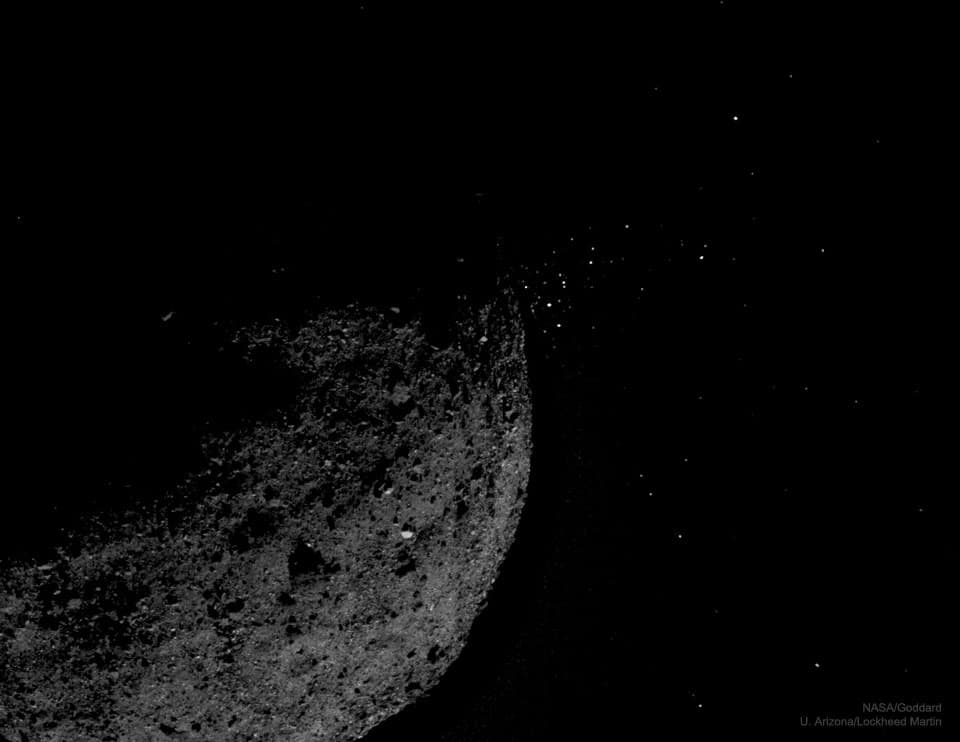
Why does asteroid Bennu eject gravel into space? No one is sure. The discovery, occurring during several episodes by NASA's visiting OSIRIS-REx spacecraft, was unexpected. Leading ejection hypotheses include impacts by Sun-orbiting meteoroids, sudden thermal fractures of internal structures, and the sudden release of a water vapor jet. The featured two-image composite shows an ejection event that occurred in early 2019, with sun-reflecting ejecta seen on the right. Data and simulations show that large gravel typically falls right back to the rotating 500-meter asteroid, while smaller rocks skip around the surface, and the smallest rocks completely escape the low gravity of the Earth approaching, diamond-shaped asteroid. Jets and surface ejection events were thought to be predominantly the domain of comets, responsible for their tails, comas, and later meteor showers on Earth. Robotic OSIRIS-REx arrived at 101955 Bennu in late 2018, and is planned to touchdown to collect a surface sample in October 2020. If all goes well, this sample will then be returned to Earth for a detailed analysis during 2023. Bennu was chosen as the destination for OSIRIS-REx in part because its surface shows potential to reveal organic compounds from the early days of our Solar System, compounds that could have been the building blocks for life on Earth. Experts Debate: How will humanity first discover extraterrestrial life?