Comet
A comet is a small Solar System body composed mainly of ice, dust, and organic compounds. As they approach the Sun, cometary ices sublimate, releasing gas and dust that form the glowing coma and distinctive tails—often extending millions of kilometers.
Comets originate from two primary reservoirs: the Kuiper Belt—home to short-period comets with orbits under ~200 years—and the distant Oort Cloud, which sends long-period comets with orbits spanning thousands of years. Occasionally, interstellar objects like ‘Oumuamua pass through our system, appearing comet-like.
They are “dirty snowballs” and among the most primitive remnants of the early Solar System, preserving original ices and organic material from 4.6 billion years ago.
Landmark missions include ESA’s Rosetta—with its lander Philae—which orbited and sampled Comet 67P/Churyumov–Gerasimenko (2014–2016). NASA’s Deep Impact struck Comet Tempel 1 in 2005 to analyze interior composition.
These missions discovered complex organic molecules, including amino-acid precursors, and supported the theory that comets may have delivered water and prebiotic compounds to early Earth.
Looking ahead, ESA–JAXA’s Comet Interceptor (launch planned for 2029) intends to perform a rapid flyby of a dynamically new or interstellar comet, using multiple spacecraft to sample both nucleus and coma environments.
Comets are studied across the electromagnetic spectrum—from radio to gamma rays—using telescopes and spacecraft to understand composition, internal structure, activity, and their roles in planetary formation, the evolution of the solar system, and the origin of life.
Sources
APODs including "Comet"
Total Solar Eclipse 2020
7 January 2021
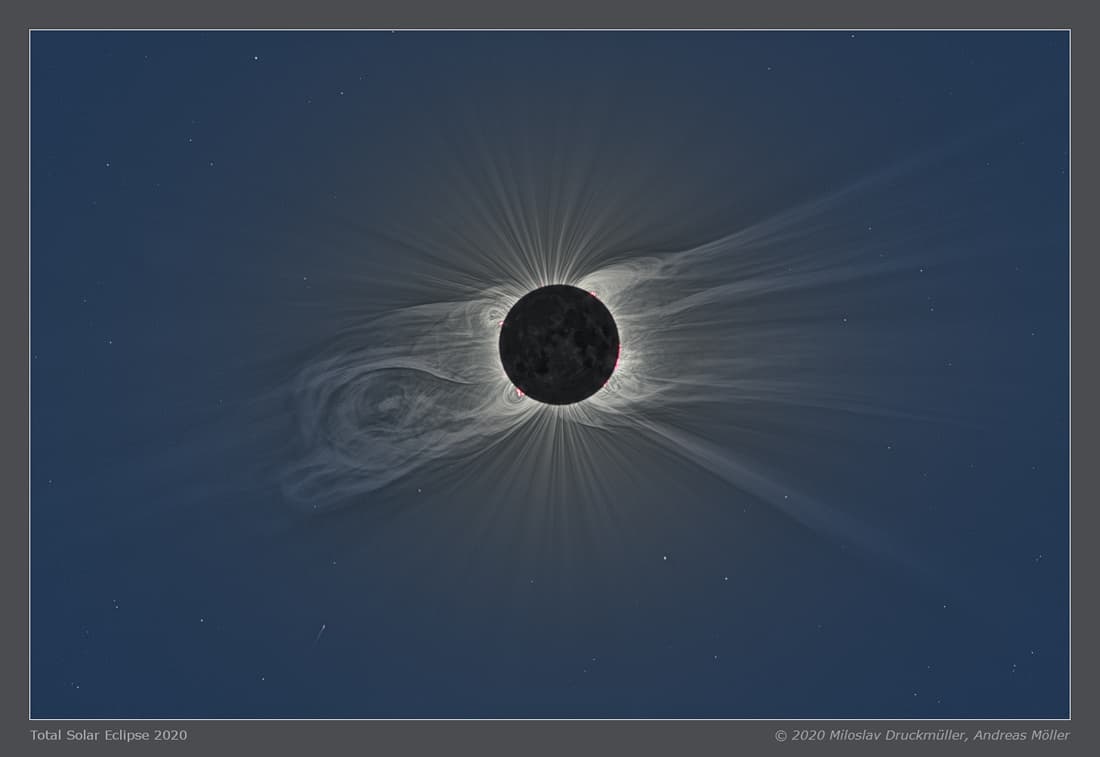
Along a narrow path crossing southern South America through Chile and Argentina, the final New Moon of 2020 moved in front of the Sun on December 14 in the year's only total solar eclipse. Within about 2 days of perigee, the closest point in its elliptical orbit, the New Moon's surface is faintly lit by earthshine in this dramatic composite view. The image is a processed composite of 55 calibrated exposures ranging from 1/640 to 3 seconds. Covering a large range in brightness during totality, it reveals the dim lunar surface and faint background stars, along with planet-sized prominences at the Sun's edge, an enormous coronal mass ejection, and sweeping coronal structures normally hidden in the Sun's glare. Look closely for an ill-fated sungrazing Kreutz family comet (C/2020 X3 SOHO) approaching from the lower left, at about the 7 o'clock position. In 2021 eclipse chasers will see an annular solar eclipse coming up on June 10. They'll have to wait until December 4 for the only total solar eclipse in 2021 though. That eclipse will be total along a narrow path crossing the southernmost continent of Antarctica.