Crab Nebula
Also known as Messier 1 (M1), the Crab Nebula is a supernova remnant resulting from a stellar explosion observed in 1054 CE. Located approximately 6,500 light-years away in the constellation Taurus, it spans about 10 light-years and is expanding at roughly 1,500 kilometers per second.
Source: apod.nasa.gov
APODs including "Crab Nebula"
Gamma Ray Crab, Geminga
24/06/1995
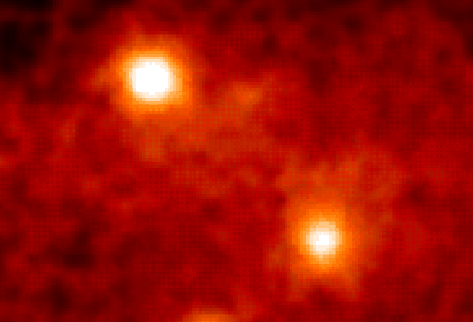
The Crab Nebula and Geminga in Gamma Rays Picture Credit: NASA, Compton Gamma Ray Observatory Explanation: What if you could "see" in gamma-rays? If you could, these two spinning neutron stars or pulsars would be among the brightest objects in the sky. This computer processed image shows the Crab Nebula pulsar (below and right of center) and the Geminga pulsar (above and left of center) in the "light" of gamma-rays. Gamma-ray photons are more than 10,000 times more energetic than visible light photons and are blocked from the Earths's surface by the atmosphere. This image was produced by the high energy gamma-ray telescope "EGRET" on board NASA's orbiting Compton Observatory satellite. For more information see Compton Science Support Center release. We keep an archive of previous Astronomy Pictures of the Day. The sky is filled with breathtaking pictures, many of which are available on the World Wide Web. Each day we feature a different picture of some part of our fascinating universe, along with a brief explanation written by a professional astronomer. Astronomy Picture of the Day is brought to you by Robert Nemiroff and Jerry Bonnell . Original material on this page is copyrighted to Robert J. Nemiroff and Jerry T. Bonnell.