Crab Nebula
Also known as Messier 1 (M1), the Crab Nebula is a supernova remnant resulting from a stellar explosion observed in 1054 CE. Located approximately 6,500 light-years away in the constellation Taurus, it spans about 10 light-years and is expanding at roughly 1,500 kilometers per second.
Source: apod.nasa.gov
APODs including "Crab Nebula"
M1: The Exploding Crab Nebula
22/11/1995
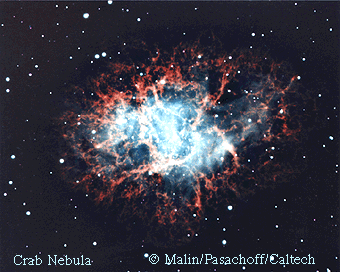
The Crab Nebula resulted from a star that exploded - a supernova. The outer layers of the star were thrown violently into space, while the inner core collapsed to form a neutron star. This neutron star is visible to us today as a pulsar - a rotating star at the center of the nebula that emits visible flashes of light. The Crab Pulsar flashes about 30 times every second. Although the stellar explosion that caused the Crab Nebula was seen over 900 years ago, the nebula itself still expands and shines. How the nebula obtains the energy needed to shine was a mystery eventually solved by noting that this energy could be released by the slowing of the pulsar's rotation.