Crab Nebula
Also known as Messier 1 (M1), the Crab Nebula is a supernova remnant resulting from a stellar explosion observed in 1054 CE. Located approximately 6,500 light-years away in the constellation Taurus, it spans about 10 light-years and is expanding at roughly 1,500 kilometers per second.
Source: apod.nasa.gov
APODs including "Crab Nebula"
The Crab Nebula Pulsar Shrugs
20/09/2002
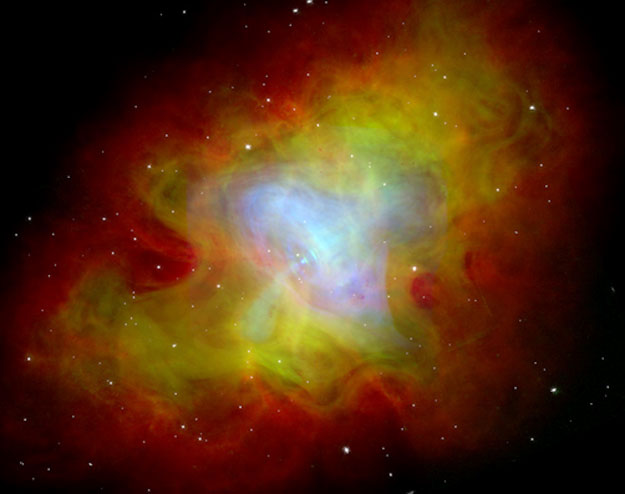
How does a city-sized neutron star power the vast Crab Nebula? The expulsion of wisps of hot gas at high speeds appears to be at least part of the answer. Yesterday time-lapse movies taken from both the Chandra X-ray Observatory and the Hubble Space Telescope were released showing a wisp of gas moving out at about half the speed of light. Wisps like this likely result from tremendous electric voltages created by the central pulsar, a rapidly rotating, magnetized, central neutron star. The hot plasma strikes existing gas, causing it glow in colors across the electromagnetic spectrum. Pictured above is a composite image of the center of the Crab Nebula where red represents radio emission, green represents visible emission, and blue represents X-ray emission. The dot at the very center is the hot pulsar spinning 30 times per second.