Crab Nebula
Also known as Messier 1 (M1), the Crab Nebula is a supernova remnant resulting from a stellar explosion observed in 1054 CE. Located approximately 6,500 light-years away in the constellation Taurus, it spans about 10 light-years and is expanding at roughly 1,500 kilometers per second.
Source: apod.nasa.gov
APODs including "Crab Nebula"
Titan's X-Ray
29/04/2004
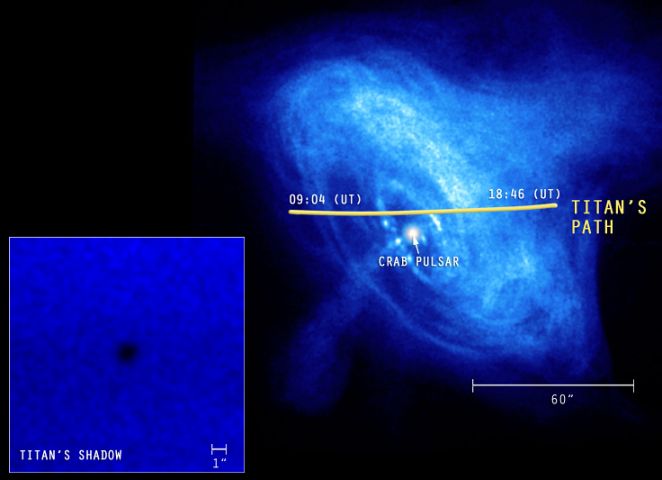
This June's rare and much heralded transit of Venus will feature our currently brilliant evening star in silhouette, as the inner planet glides across the face of the Sun. But on January 5, 2003 an even rarer transit took place. Titan, large moon of ringed gas giant Saturn, crossed in front of the Crab Nebula, a supernova remnant some 7,000 light-years away. During Titan's transit, the orbiting Chandra Observatory's x-ray detectors recorded the shadowing of cosmic x-rays generated by the Crab's amazing pulsar nebula, pictured above, in a situation analogous to a medical x-ray. The resulting image (inset at left) probes the extent of Titan's atmosphere. So, how rare was Titan's transit of the Crab? While Saturn itself passes within a few degrees of the Crab Nebula every 30 years, the next similar transit is reportedly due in 2267. And since the stellar explosion which gave birth to the Crab was seen in 1054, the 2003 Titan transit may have been the first to occur ... ever.