European Southern Observatory
The European Southern Observatory (ESO) is an intergovernmental organization founded in 1962 and supported by 16 member states and host country Chile. ESO designs, builds, and operates some of the world's most advanced ground-based astronomical observatories—such as La Silla, Paranal (home to the Very Large Telescope and other survey instruments), and the Atacama Large Millimeter/submillimeter Array (ALMA)—and is currently constructing the Extremely Large Telescope (ELT).
Source: eso.org
APODs including "European Southern Observatory"
A Dust Jet From Hale-Bopp
29/07/1996
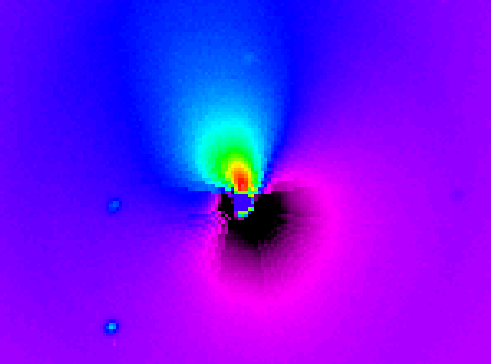
Approaching the inner Solar System, comet Hale-Bopp's icy nucleus is heated by sunlight, accelerating its production of dust and gas. Shrouded in the resulting cloud, known as the coma, the cometary nucleus remains hidden from direct view. However, astronomers using a 2.2 meter telescope at the European Southern Observatory in May, were able to detect an enormous jet of dust extending northward (up) from the nuclear region as seen in this false color image. Dust jets may arise from vents on the surface of the nucleus. Early estimates of the size of Hale-Bopp's nucleus have indicated that it could be as large as 40 kilometers (24 miles) in diameter -- several times larger than comet Halley's. Hale-Bopp's copious dust production bodes well for it becoming a bright naked-eye comet in the spring of 1997.