European Southern Observatory
The European Southern Observatory (ESO) is an intergovernmental organization founded in 1962 and supported by 16 member states and host country Chile. ESO designs, builds, and operates some of the world's most advanced ground-based astronomical observatories—such as La Silla, Paranal (home to the Very Large Telescope and other survey instruments), and the Atacama Large Millimeter/submillimeter Array (ALMA)—and is currently constructing the Extremely Large Telescope (ELT).
Source: eso.org
APODs including "European Southern Observatory"
How Big Is 2001 KX76?
30/08/2001
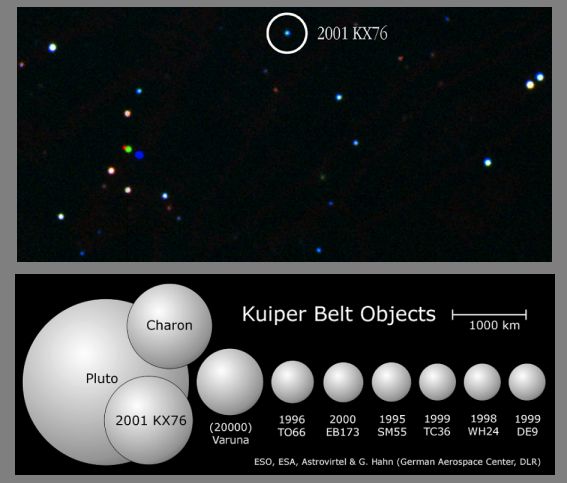
Newly discovered minor planet 2001 KX76 is circled in the top panel above, a recent composite image from the European Southern Observatory's 2.2 meter telescope at La Silla, Chile. Though 2001 KX76 appears here as single point of light in an unremarkable star field, its orbit has been accurately measured by Astrovirtel, a newly operational "virtual telescope" capable of mining many years of archival data for previously unrecognized images of 2001 KX76. The results show this minor planet to be very distant, now orbiting just beyond Pluto and Charon in the realm of the Kuiper Belt. At its distance, apparent brightness, and assuming a reasonable surface reflectivity, 2001 KX76 would be 1,200 kilometers or more across -- larger than the largest main-belt asteroid, Ceres. In fact, the illustration in the bottom panel graphically compares this size estimate to Pluto, Charon, and the largest previously known Kuiper Belt objects, indicating the newfound minor planet is second only to Pluto in diameter. Along with other evidence, the comparison suggests that Pluto and Charon are closely related to Kuiper Belt worlds like 2001 KX76.