European Southern Observatory
The European Southern Observatory (ESO) is an intergovernmental organization founded in 1962 and supported by 16 member states and host country Chile. ESO designs, builds, and operates some of the world's most advanced ground-based astronomical observatories—such as La Silla, Paranal (home to the Very Large Telescope and other survey instruments), and the Atacama Large Millimeter/submillimeter Array (ALMA)—and is currently constructing the Extremely Large Telescope (ELT).
Source: eso.org
APODs including "European Southern Observatory"
Nebulas Surrounding Wolf-Rayet Binary BAT99-49
21/04/2004
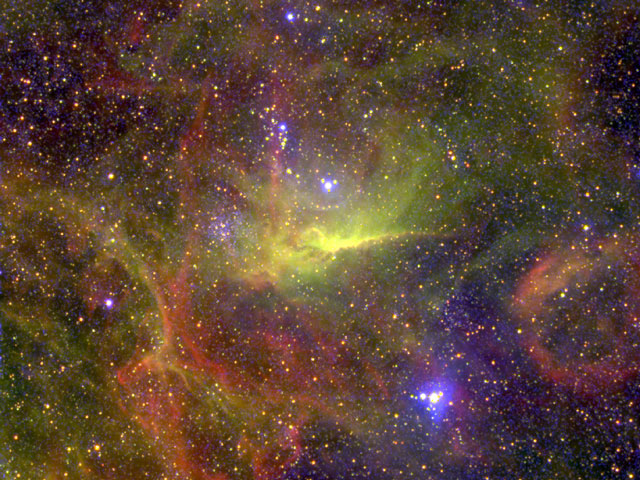
How could two young stars power these colorful interstellar gas clouds? Although hidden by thick dust, the stars spew forceful ions and energetic radiation that cause the clouds to fragment and light up. The above composite color image from the European Southern Observatory's Melipal VLT telescope resolves details in the nebula complex known as BAT99-49, with emission from helium atoms in blue hues, oxygen atoms in green, and hydrogen atoms in red. Located in the Large Magellanic Cloud (LMC), the largest satellite galaxy to our own Milky Way Galaxy, one of the stars in the central binary is an enigmatic Wolf-Rayet star while the other is a massive O star. Wolf-Rayet stars have some of the hottest surfaces in the universe, while O stars are the most massive and energetic of normal main sequence stars.