Event Horizon
An event horizon is the boundary around a black hole beyond which nothing—not even light—can escape. It marks the point where the escape velocity equals the speed of light.
From an outside observer's perspective, objects falling toward the horizon appear to slow down and redden due to gravitational time dilation and redshift, fading gradually but never seeming to cross the boundary.
In contrast, an object falling into the hole would cross the horizon in a finite time according to its own clock and would not experience any dramatic effects at that exact boundary in large black holes—no ‘wall’ or sudden force at the horizon itself.
The radius of a non-rotating black hole’s event horizon is called the Schwarzschild radius, which depends on the mass of the black hole: larger mass equals a larger horizon.
Once past the event horizon, all future paths lead inward—toward the singularity. Light cones tip inward, making escape physically impossible, trapping matter and information within.
The Event Horizon Telescope produced the first direct images of black hole shadows, observing the silhouette of the M87* and Sagittarius A* supermassive black holes, providing strong evidence for the existence and properties of event horizons.
Event horizons are not material surfaces but mathematical boundaries derived from spacetime geometry. Quantum effects near horizons—such as Hawking radiation—cause black holes to slowly evaporate over extremely long timescales.
Sources
APODs including "Event Horizon"
Black Holes Signature From Advective Disks Research Credit:
15 January 1997
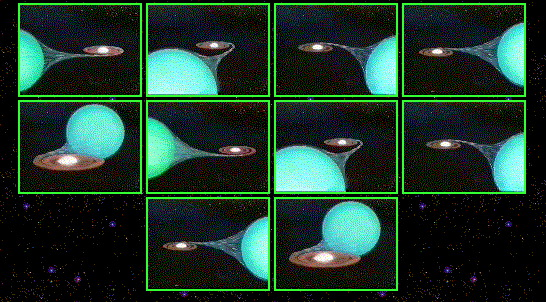
What does a black hole look like? If alone, a black hole would indeed appear quite black, but many black hole candidates are part of binary star systems. So how does a black hole binary system look different from a neutron star binary system? The above drawings indicate it is difficult to tell! Recent theoretical work, however, has provided a new way to tell them apart: advective accretion flows (ADAFs). A black hole system so equipped would appear much darker than a similar neutron star system. The difference is caused by the hot gas from the ADAF disk falling through the event horizon of the black hole and disappearing - gas that would have emitted much light were the central object only a neutron star. Recent observations of the soft X-ray transient V404 Cyg has yielded a spectrum much like an ADAF onto a black hole - and perhaps brighter than allowable from an ADAF onto a neutron star.