Event Horizon
An event horizon is the boundary around a black hole beyond which nothing—not even light—can escape. It marks the point where the escape velocity equals the speed of light.
From an outside observer's perspective, objects falling toward the horizon appear to slow down and redden due to gravitational time dilation and redshift, fading gradually but never seeming to cross the boundary.
In contrast, an object falling into the hole would cross the horizon in a finite time according to its own clock and would not experience any dramatic effects at that exact boundary in large black holes—no ‘wall’ or sudden force at the horizon itself.
The radius of a non-rotating black hole’s event horizon is called the Schwarzschild radius, which depends on the mass of the black hole: larger mass equals a larger horizon.
Once past the event horizon, all future paths lead inward—toward the singularity. Light cones tip inward, making escape physically impossible, trapping matter and information within.
The Event Horizon Telescope produced the first direct images of black hole shadows, observing the silhouette of the M87* and Sagittarius A* supermassive black holes, providing strong evidence for the existence and properties of event horizons.
Event horizons are not material surfaces but mathematical boundaries derived from spacetime geometry. Quantum effects near horizons—such as Hawking radiation—cause black holes to slowly evaporate over extremely long timescales.
Sources
APODs including "Event Horizon"
Black Holes Are Black
19 January 2001
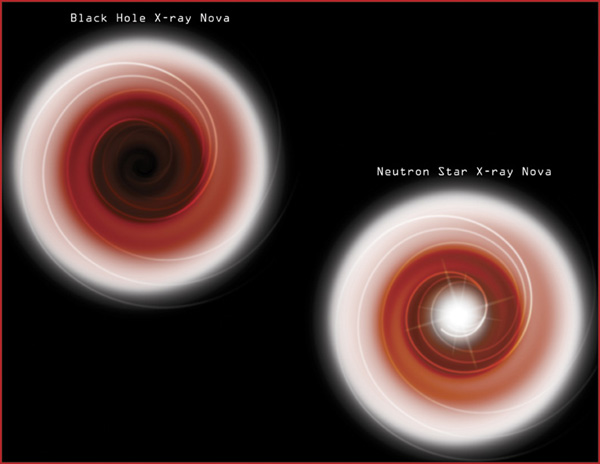
Q: Why are black holes black? A: Because they have an event horizon. The event horizon is that one-way boundary predicted by general relativity beyond which nothing, not even light, can return. X-ray astronomers using the space-based Chandra Observatory now believe they have direct evidence for event horizons - therefore black holes - in binary star systems which can be detected in x-ray light. These binaries, sometimes called x-ray novae, are known to consist of relatively normal stars dumping material on to massive, compact companions. As illustrated, the material swirls toward the companion in an accretion disk which itself glows in x-rays. If the compact companion is a neutron star (right), the material ultimately smashes into the solid surface and glows even more brightly in high energy x-rays. But if it is indeed a black hole with a defining event horizon, then the x-ray hot material approaches the speed of light as it swirls past the surface of no return and is lost from view. Recent work describes observations of two classes of x-ray binaries, one class 100 times fainter than the other. The results imply the presence of an event horizon in the fainter class which causes the extreme difference in x-ray brightness.