Event Horizon
An event horizon is the boundary around a black hole beyond which nothing—not even light—can escape. It marks the point where the escape velocity equals the speed of light.
From an outside observer's perspective, objects falling toward the horizon appear to slow down and redden due to gravitational time dilation and redshift, fading gradually but never seeming to cross the boundary.
In contrast, an object falling into the hole would cross the horizon in a finite time according to its own clock and would not experience any dramatic effects at that exact boundary in large black holes—no ‘wall’ or sudden force at the horizon itself.
The radius of a non-rotating black hole’s event horizon is called the Schwarzschild radius, which depends on the mass of the black hole: larger mass equals a larger horizon.
Once past the event horizon, all future paths lead inward—toward the singularity. Light cones tip inward, making escape physically impossible, trapping matter and information within.
The Event Horizon Telescope produced the first direct images of black hole shadows, observing the silhouette of the M87* and Sagittarius A* supermassive black holes, providing strong evidence for the existence and properties of event horizons.
Event horizons are not material surfaces but mathematical boundaries derived from spacetime geometry. Quantum effects near horizons—such as Hawking radiation—cause black holes to slowly evaporate over extremely long timescales.
Sources
APODs including "Event Horizon"
Possible Jet Blown Shells Near Microquasar Cygnus X-1
8 June 2009
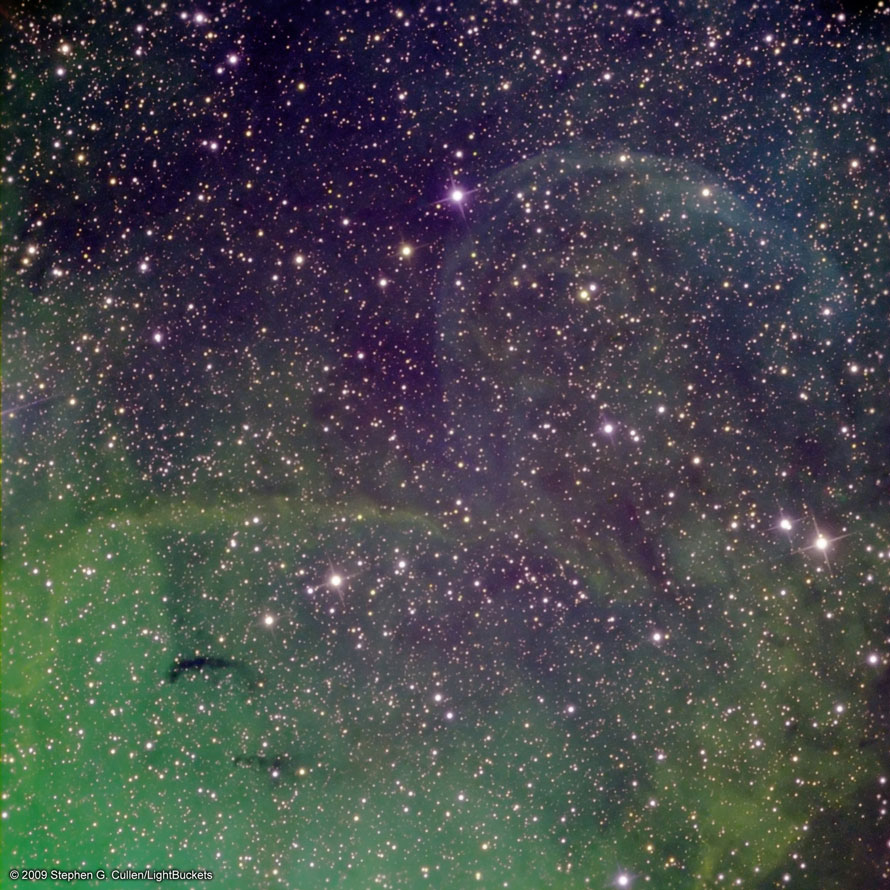
What happens to matter that falls toward an energetic black hole? In the case of Cygnus X-1, perhaps little of that matter actually makes it in. Infalling gas may first collide not only with itself but with an accretion disk of swirling material surrounding the black hole. The result may be a microquasar that glows across the electromagnetic spectrum and produces powerful jets that expel much of the infalling matter back into the cosmos at near light speed before it can even approach the black hole's event horizon. Confirmation that black hole jets may create expanding shells has come recently from the discovery of shells surrounding Cygnus X-1. Pictured above on the upper right is one such shell quite possibly created by the jet of microquasar and black hole candidate Cygnus X-1. Rolling your cursor over the image will bring up an annotated version. The physical processes that create the black hole jets is a topic that continues to be researched.