Event Horizon
An event horizon is the boundary around a black hole beyond which nothing—not even light—can escape. It marks the point where the escape velocity equals the speed of light.
From an outside observer's perspective, objects falling toward the horizon appear to slow down and redden due to gravitational time dilation and redshift, fading gradually but never seeming to cross the boundary.
In contrast, an object falling into the hole would cross the horizon in a finite time according to its own clock and would not experience any dramatic effects at that exact boundary in large black holes—no ‘wall’ or sudden force at the horizon itself.
The radius of a non-rotating black hole’s event horizon is called the Schwarzschild radius, which depends on the mass of the black hole: larger mass equals a larger horizon.
Once past the event horizon, all future paths lead inward—toward the singularity. Light cones tip inward, making escape physically impossible, trapping matter and information within.
The Event Horizon Telescope produced the first direct images of black hole shadows, observing the silhouette of the M87* and Sagittarius A* supermassive black holes, providing strong evidence for the existence and properties of event horizons.
Event horizons are not material surfaces but mathematical boundaries derived from spacetime geometry. Quantum effects near horizons—such as Hawking radiation—cause black holes to slowly evaporate over extremely long timescales.
Sources
APODs including "Event Horizon"
The Quiet Sagittarius A*
6 September 2013
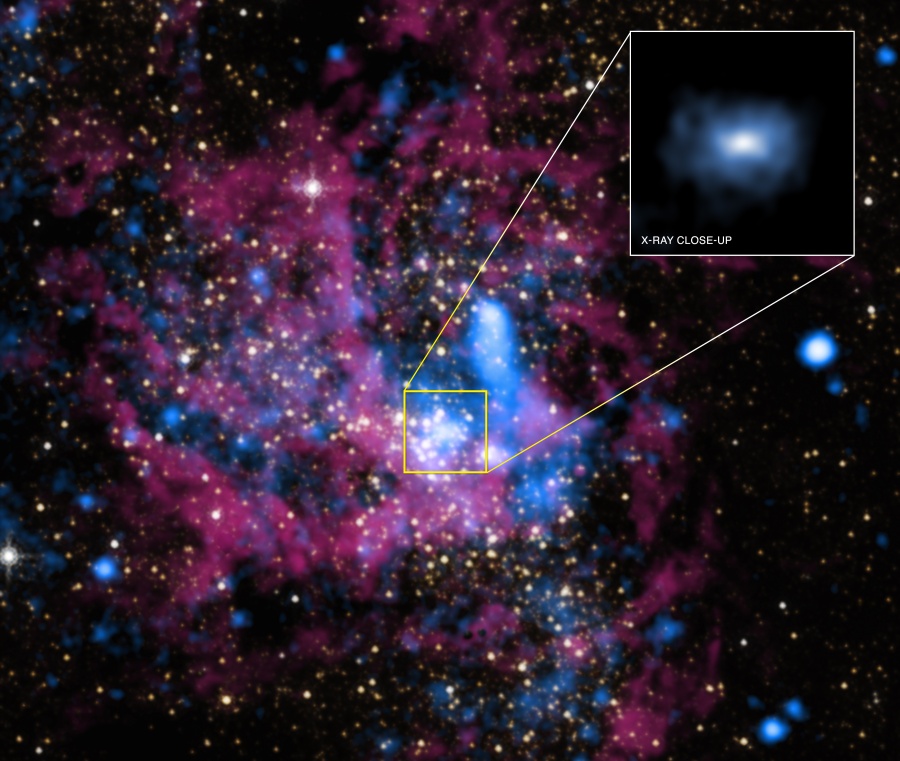
Hot gas is hard to swallow. At least that seems to be true for the supermassive black hole at the center of our Milky Way Galaxy. Known as source Sagittarius A*, the Milky Way's black hole is centered in this infrared (red and yellow hues) and X-ray (blue) composite. Based on data from an extensive campaign of observations by the orbiting Chandra X-ray telescope, the diffuse emission surrounding the black hole is seen in the close-up inset, the inset field spanning about 1/2 light-year across the galactic center some 26,000 light-years away. Astronomers have found that the X-ray emission originates in hot gas drawn from the winds of massive young stars in the region. The Chandra data indicate that only about 1% or less of the gas within the black hole's gravitational influence ever reaches the event horizon, losing enough heat and angular momentum to fall into the black hole, while the rest of the gas escapes in an outflow. The result explains why the Milky Way's black hole is so quiet, much fainter than might be expected in energetic X-rays. It likely holds for most supermassive black holes in galaxies in the nearby Universe.