Event Horizon
An event horizon is the boundary around a black hole beyond which nothing—not even light—can escape. It marks the point where the escape velocity equals the speed of light.
From an outside observer's perspective, objects falling toward the horizon appear to slow down and redden due to gravitational time dilation and redshift, fading gradually but never seeming to cross the boundary.
In contrast, an object falling into the hole would cross the horizon in a finite time according to its own clock and would not experience any dramatic effects at that exact boundary in large black holes—no ‘wall’ or sudden force at the horizon itself.
The radius of a non-rotating black hole’s event horizon is called the Schwarzschild radius, which depends on the mass of the black hole: larger mass equals a larger horizon.
Once past the event horizon, all future paths lead inward—toward the singularity. Light cones tip inward, making escape physically impossible, trapping matter and information within.
The Event Horizon Telescope produced the first direct images of black hole shadows, observing the silhouette of the M87* and Sagittarius A* supermassive black holes, providing strong evidence for the existence and properties of event horizons.
Event horizons are not material surfaces but mathematical boundaries derived from spacetime geometry. Quantum effects near horizons—such as Hawking radiation—cause black holes to slowly evaporate over extremely long timescales.
Sources
APODs including "Event Horizon"
Swirling Magnetic Field around Our Galaxy's Central Black Hole
1 April 2024
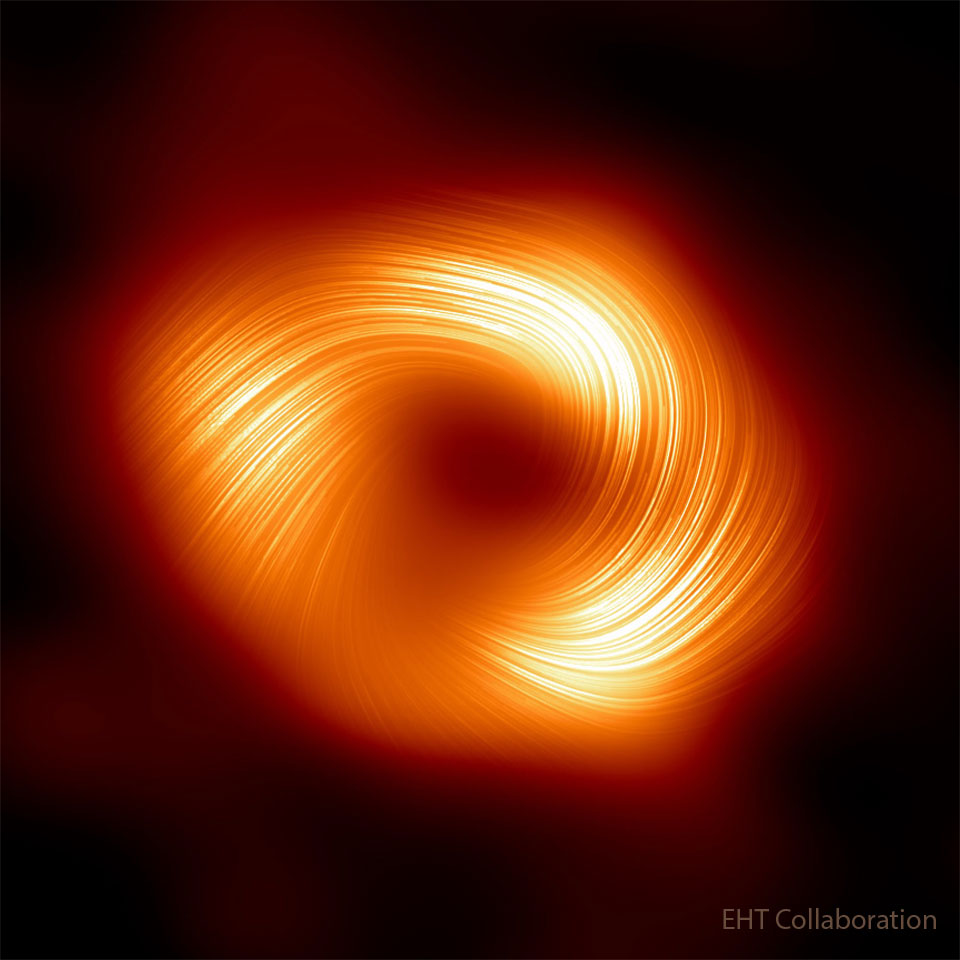
What's happening to the big black hole in the center of our galaxy? It is sucking in matter from a swirling disk -- a disk that is magnetized, it has now been confirmed. Specifically, the black hole's accretion disk has recently been seen to emit polarized light, radiation frequently associated with a magnetized source. Pictured here is a close-up of Sgr A*, our Galaxy's central black hole, taken by radio telescopes around the world participating in the Event Horizon Telescope (EHT) Collaboration. Superposed are illustrative curved lines indicating polarized light likely emitted from swirling magnetized gas that will soon fall into the 4+ million solar mass central black hole. The central part of this image is likely dark because little light-emitting gas is visible between us and the dark event horizon of the black hole. Continued EHT monitoring of this and M87's central black hole may yield new clues about the gravity of black holes and how infalling matter creates disks and jets. NASA Predicts: Moon to Get in Way of Sun