False Color
A method of representing data where colors are assigned to specific ranges of values, often used in astronomical imaging to visualize wavelengths outside the visible spectrum.
Source: earthobservatory.nasa.gov
APODs including "False Color"
Uranus' Ring System
30/04/1996
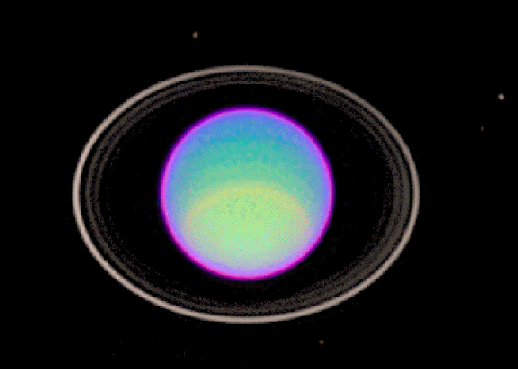
The rings of Uranus are thin, narrow, and dark compared to other planetary ring systems. Brightened artificially by computer, the ring particles reflect as little light as charcoal, although they are really made of ice chucks darkened by rock. This false-color, infrared picture from the Hubble Space Telescope taken in July 1995 shows the rings in conjunction to the planet. The infrared light allows one to see detail in different layers of Uranus' atmosphere, which has been digitally enhanced with false color. Three other planets in our Solar System are known to have rings: Jupiter, Saturn, and Neptune. Four of Uranus' moons are visible outside the ring plane. The rings of Uranus were discovered from ground-based observations in 1977.