False Color
A method of representing data where colors are assigned to specific ranges of values, often used in astronomical imaging to visualize wavelengths outside the visible spectrum.
Source: earthobservatory.nasa.gov
APODs including "False Color"
X-Rays From IC 443 Credit:
02/05/1997
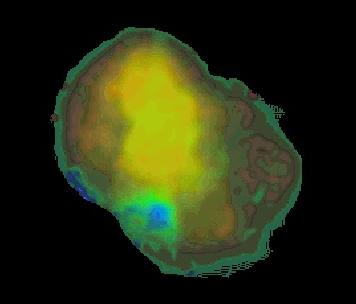
The life-cycles of stars help drive the ecology of our Galaxy, churning, processing, and redistributing matter. Massive stars reach a spectacular evolutionary endpoint - supernovae explosions which blast off their outer layers, violently merging stellar material with the gas and dust of the Milky Way. The supernova remnant IC 443 is typical of the aftermath. Seen in this false color X-ray image are the shocked, expanding shells of gas from a star which exploded thousands of years ago. Known to be interacting with galactic molecular clouds, the expanding supernova remnant was also recently discovered to have regions of intense higher energy X-ray emission (coded blue in this map) near the molecular cloud boundaries. This X-ray emission may indicate that electrons are being accelerated within the remnant, gaining in energy as they surf back and forth across the expanding shock wave. If so, IC 443 could also be one source of our Galaxy's puzzling high energy cosmic-rays.