False Color
A method of representing data where colors are assigned to specific ranges of values, often used in astronomical imaging to visualize wavelengths outside the visible spectrum.
Source: earthobservatory.nasa.gov
APODs including "False Color"
IC 5067: Emission Nebula Close-up
27/12/2006
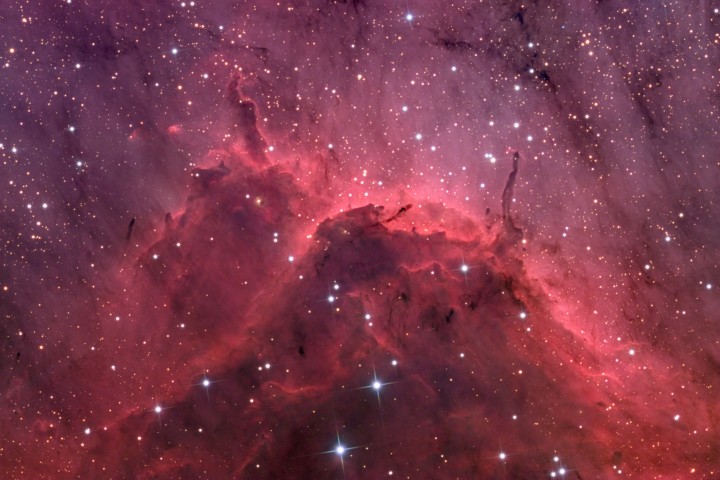
This amazing skyscape lies along a bright ridge of emission in IC 5067, also known as The Pelican Nebula. Appropriately, the Pelican Nebula itself is part of a much larger, complex star-forming region about 2,000 light-years away in the high flying constellation Cygnus, the Swan. Cosmic dust clouds that span light-years seem to rise like mountains in the mist in this natural color view, recorded through broadband filters to produce an analogy to human color vision. The fantastic shapes are sculpted by winds and radiation from a hot, massive stars and the dominant red emission is due to atomic hydrogen gas. Placing your cursor on the image will bring up a false color image of the nebula made through narrowband filters that also map specific emission from sulfur and oxygen atoms. The mapped color image reveals even more details of the cosmic clouds and their composition.