False Color
A method of representing data where colors are assigned to specific ranges of values, often used in astronomical imaging to visualize wavelengths outside the visible spectrum.
Source: earthobservatory.nasa.gov
APODs including "False Color"
Seven Dusty Sisters
13/04/2007
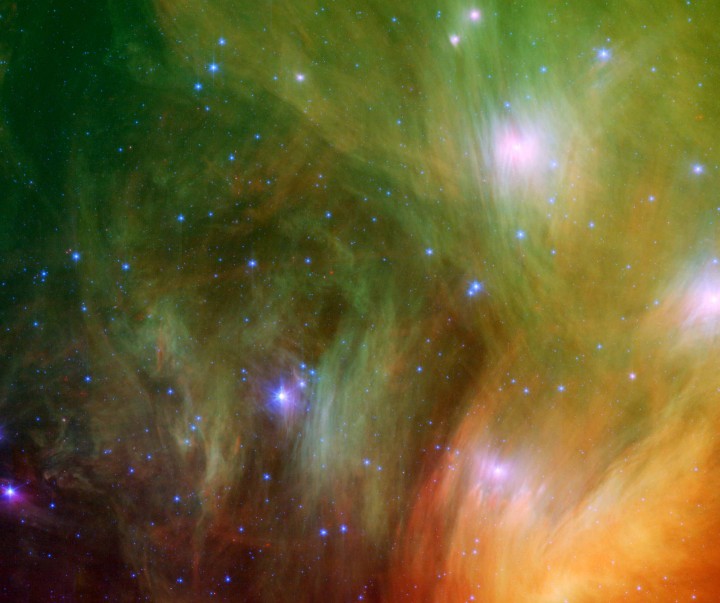
Hurtling through a cosmic dust cloud a mere 400 light-years away, the lovely Pleiades or Seven Sisters star cluster is well-known in astronomical images for its striking blue reflection nebulae. At visible wavelengths, the starlight is scattered and reflected by the dust, but in this portrait in infrared light by the Spitzer Space Telescope, the dust itself glows. The false color image spans about 1 degree or seven light-years at the distance of the Pleiades, with the densest regions of the dust cloud shown in yellow and red hues. Exploring this young, nearby cluster, the Spitzer data have revealed many cool, low mass stars, brown dwarfs or failed stars, and possible planetary debris disks. Want to see the Pleiades tonight? Look near Venus, the brilliant evening star in the west just after sunset.