False Color
A method of representing data where colors are assigned to specific ranges of values, often used in astronomical imaging to visualize wavelengths outside the visible spectrum.
Source: earthobservatory.nasa.gov
APODs including "False Color"
IC 5067 in the Pelican Nebula
19/10/2007
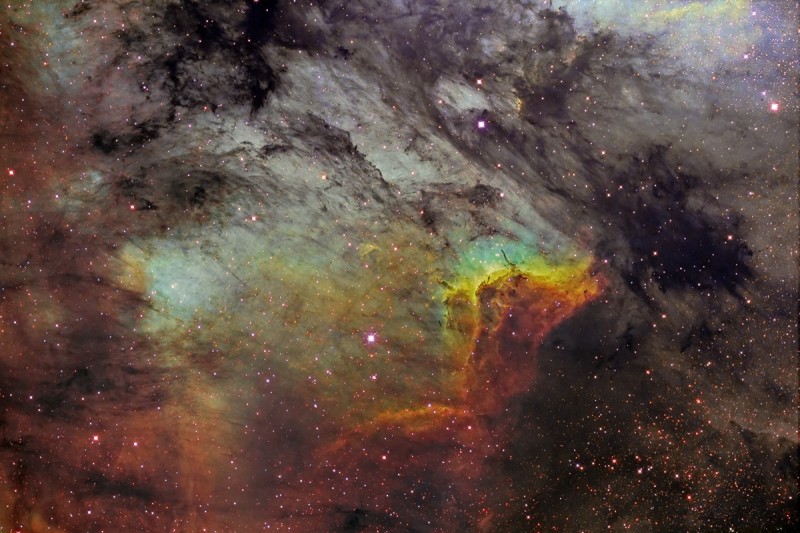
The prominent ridge of emission featured in this dramatic skyscape is cataloged as IC 5067. Part of a larger emission nebula with a distinctive shape, popularly called The Pelican Nebula, the ridge spans about 10 light-years following the curve of the cosmic pelican's head and neck. This false color view also translates the pervasive glow of narrow emission lines from atoms in the nebula to a color palette made popular in Hubble Space Telescope images of star forming regions. Fantastic, dark shapes inhabiting the 1/2 degree wide field are clouds of cool gas and dust sculpted by the winds and radiation from hot, massive stars. Close-ups of some of the sculpted clouds show clear signs of newly forming stars. The Pelican Nebula, itself cataloged as IC 5070, is about 2,000 light-years away. To find it, look northeast of bright star Deneb in the high flying constellation Cygnus. A new APOD RSS feed is available here, or from the link line below.