False Color
A method of representing data where colors are assigned to specific ranges of values, often used in astronomical imaging to visualize wavelengths outside the visible spectrum.
Source: earthobservatory.nasa.gov
APODs including "False Color"
MAVEN at Mars
26/09/2014
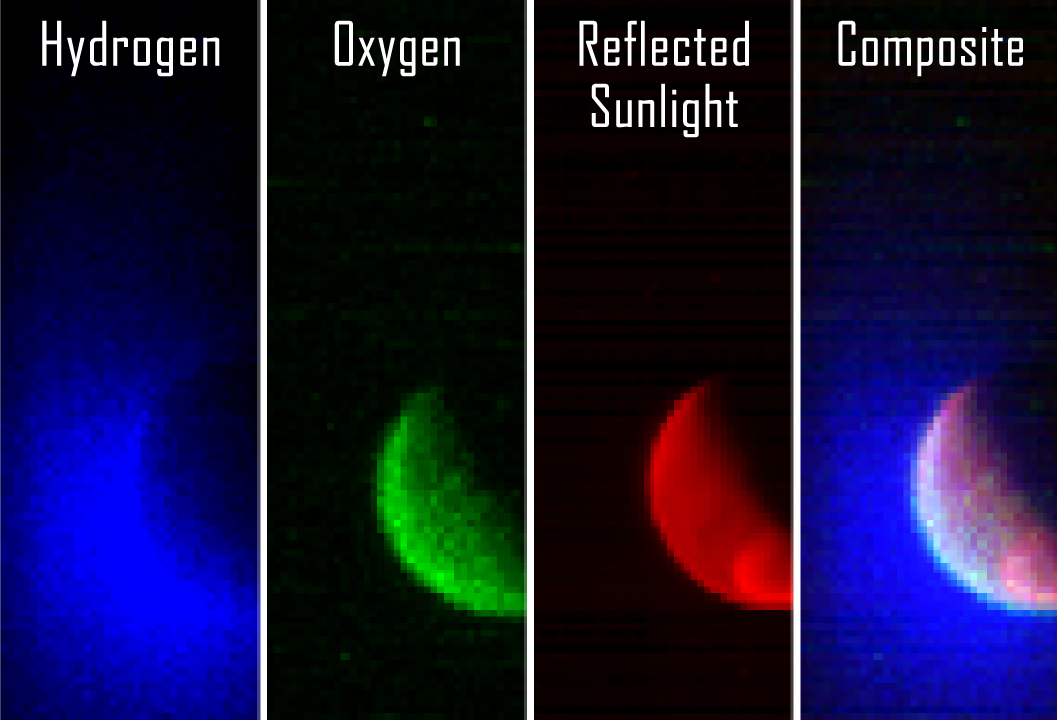
Launched on November 18, 2013, the MAVEN (Mars Atmosphere and Volatile EvolutioN) spacecraft completed its interplanetary voyage September 21, captured into a wide, elliptical orbit around Mars. MAVEN's imaging ultraviolet spectrograph has already begun its planned exploration of the Red Planet's upper atmosphere, acquiring this image data from an altitude of 36,500 kilometers. In false color, the three ultraviolet wavelength bands show light reflected from atomic hydrogen (in blue), atomic oxygen (in green) and the planet's surface (in red). Low mass atomic hydrogen is seen to extend thousands of kilometers into space, with the cloud of more massive oxygen atoms held closer by Mars' gravity. Both are by products of the breakdown of water and carbon dioxide in Mars' atmosphere and the MAVEN data can be used to determine the rate of water loss over time. In fact, MAVEN is the first mission dedicated to exploring Mars' tenuous upper atmosphere, ionosphere and interactions with the Sun and solar wind. But the most recent addition to the fleet of spacecraft from planet Earth now in martian orbit is MOM.