Galactic Plane
The Galactic Plane is the plane in which the majority of a disk-shaped galaxy's mass lies. In the case of the Milky Way, it is the plane of the galaxy's disk, encompassing the spiral arms, stars, gas, and dust. This plane is used as the reference for the galactic coordinate system.
Source: asd.gsfc.nasa.gov
APODs including "Galactic Plane"
Fermi's Gamma-Ray Sky
21/03/2009
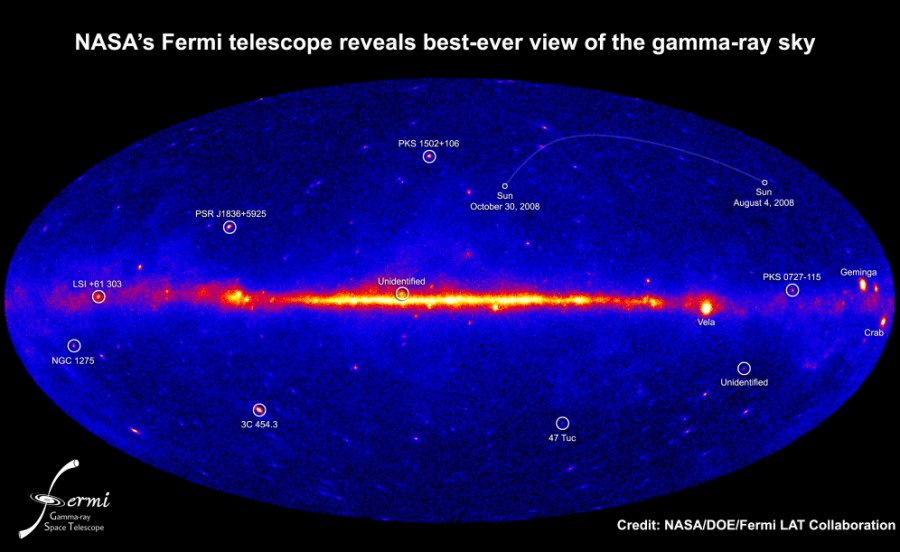
Scanning the entire sky in gamma-rays, photons with over 50 million times the energy of visible light, the Fermi mission's Large Area Telescope (LAT) explores the high-energy universe. This all-sky map constructed from 3 months of LAT observations (August 4 to October 30, 2008) represents a deeper, better-resolved view of the gamma-ray sky than any previous space mission. What shines in Fermi's gamma-ray sky? A new paper describes the 205 brightest gamma-ray sources, but this map highlights a Fermi "top ten" list of five sources within, and five sources that lie beyond our Milky Way Galaxy. Within our galaxy: the Sun traces a faint arc across the map between the observation dates, LSI +61 303 is an X-ray binary star about 6,500 light-years away, PSR J1836+5925 is a type of pulsar (spinning neutron star) that is only seen to pulse at gamma-ray energies, and 47 Tuc is a globular star cluster some 15,000 light-years away. A fifth galactic source (unidentified), just above the center of the galactic plane, is intriguing because it is a variable source and has no clear counterpart at other wavelengths. Beyond our galaxy: NGC 1275 is a large galaxy at the heart of the Perseus galaxy cluster some 233 million light-years away, while 3C 454.3, PKS 1502+106, and PKS 0727-115 are active galaxies billions of light-years distant. Another unidentified source, seen below the galactic plane, is likely beyond the boundaries of the Milky Way. Its nature remains a mystery.