Galactic Plane
The Galactic Plane is the plane in which the majority of a disk-shaped galaxy's mass lies. In the case of the Milky Way, it is the plane of the galaxy's disk, encompassing the spiral arms, stars, gas, and dust. This plane is used as the reference for the galactic coordinate system.
Source: asd.gsfc.nasa.gov
APODs including "Galactic Plane"
The Reddening of M71
10/12/2014
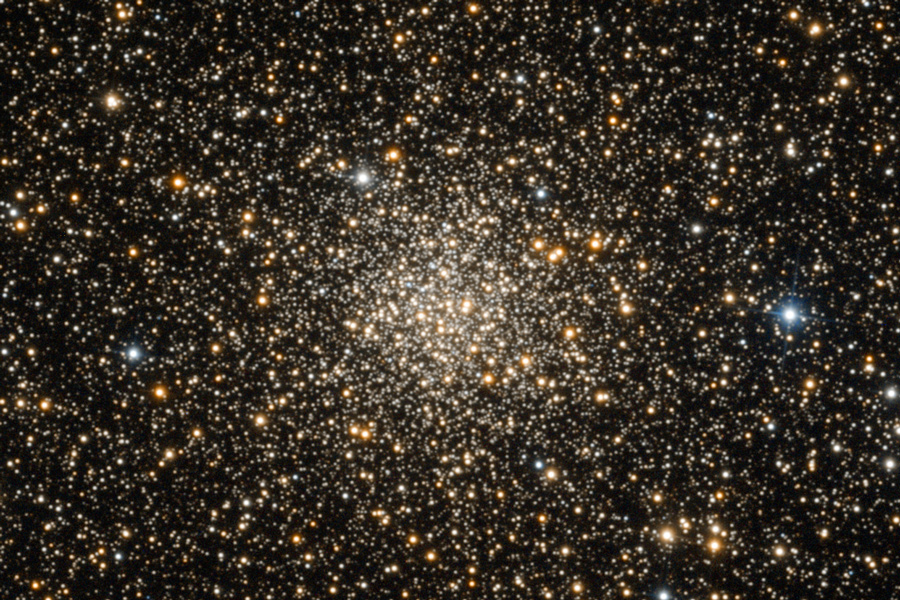
Now known to be a globular star cluster at the tender age of 10 billion years, M71 is a mere 13,000 light-years away within the narrow boundaries of the faint constellation Sagitta. Close to the plane of the Milky Way galaxy in planet Earth's sky, its 10,000 or so member stars are gathered into a region about 27 light-years across near the center of this color composite view. In fact, the line-of-sight to M71 passes along the galactic plane through much intervening diffuse interstellar dust. The dust dims starlight and scatters blue light more efficiently, masking the brightness of M71's stars and shifting true star colors toward the red. How much are the star colors shifted? Slide your cursor over the image (or follow this link) to use an estimate of the dust reddening or galactic extinction to correct the star colors in M71. Corrections to the brightness and colors of M71 member stars are needed to measure the cluster's distance and age using a Color-Magnitude diagram.