Galaxy Cluster
Galaxy clusters are the most massive gravitationally bound structures in the Universe, containing hundreds to thousands of galaxies, vast amounts of hot gas, and a dominant component of dark matter. Typical masses range from 10¹⁴ to 10¹⁵ M☉ (solar masses), and sizes span several million light‑years.
These clusters form through hierarchical growth: smaller galaxy groups merge over time to create larger clusters. They are the primary building blocks of the cosmic web and serve as anchors for superclusters.
Most of a cluster’s mass resides in dark matter, inferred from galaxy motions and gravitational lensing. The intracluster medium (ICM) is made of hot plasma at tens of millions of Kelvin, emitting X‑rays observable by telescopes like Chandra and XMM‑Newton.
Galaxy clusters reveal fundamental physics. Fritz Zwicky first inferred dark matter in the 1930s by noting galaxies moved too quickly to be held by visible mass. Detailed X‑ray and lensing studies confirm that visible galaxies make up only ~1%, while ICM is ~9% and dark matter comprises ~90% of cluster mass.
Clusters are cosmological tools. Measurements of their number, mass distribution, and growth trace the nature of dark energy and the evolution of large-scale structure.
They also act as gravitational lenses: their mass bends light from distant galaxies, magnifying and distorting background sources—used to study high-redshift galaxies and map mass distribution.
Galaxy clusters include familiar nearby examples like the Virgo Cluster, Coma Cluster, and the Perseus Cluster. They also host extreme systems such as the Bullet Cluster—where colliding subclusters provide compelling evidence for dark matter—and distant massive clusters located over 10 billion light‑years away.
Modern observatories like Hubble, Chandra, and JWST continue to probe cluster dynamics, star formation, black hole growth, and dark matter profiles within these colossal systems.
Sources
APODs including "Galaxy Cluster"
Fermi's Gamma-Ray Sky
21 March 2009
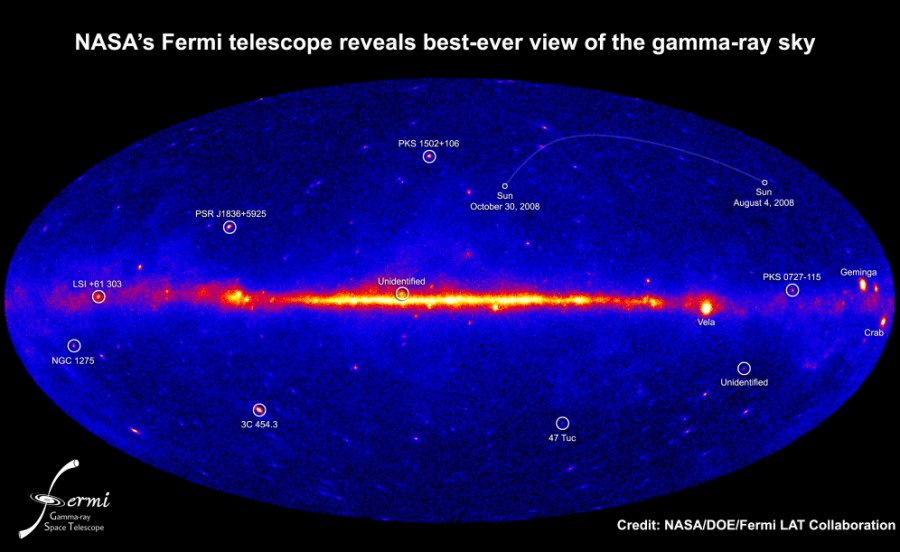
Scanning the entire sky in gamma-rays, photons with over 50 million times the energy of visible light, the Fermi mission's Large Area Telescope (LAT) explores the high-energy universe. This all-sky map constructed from 3 months of LAT observations (August 4 to October 30, 2008) represents a deeper, better-resolved view of the gamma-ray sky than any previous space mission. What shines in Fermi's gamma-ray sky? A new paper describes the 205 brightest gamma-ray sources, but this map highlights a Fermi "top ten" list of five sources within, and five sources that lie beyond our Milky Way Galaxy. Within our galaxy: the Sun traces a faint arc across the map between the observation dates, LSI +61 303 is an X-ray binary star about 6,500 light-years away, PSR J1836+5925 is a type of pulsar (spinning neutron star) that is only seen to pulse at gamma-ray energies, and 47 Tuc is a globular star cluster some 15,000 light-years away. A fifth galactic source (unidentified), just above the center of the galactic plane, is intriguing because it is a variable source and has no clear counterpart at other wavelengths. Beyond our galaxy: NGC 1275 is a large galaxy at the heart of the Perseus galaxy cluster some 233 million light-years away, while 3C 454.3, PKS 1502+106, and PKS 0727-115 are active galaxies billions of light-years distant. Another unidentified source, seen below the galactic plane, is likely beyond the boundaries of the Milky Way. Its nature remains a mystery.