Galaxy Cluster
Galaxy clusters are the most massive gravitationally bound structures in the Universe, containing hundreds to thousands of galaxies, vast amounts of hot gas, and a dominant component of dark matter. Typical masses range from 10¹⁴ to 10¹⁵ M☉ (solar masses), and sizes span several million light‑years.
These clusters form through hierarchical growth: smaller galaxy groups merge over time to create larger clusters. They are the primary building blocks of the cosmic web and serve as anchors for superclusters.
Most of a cluster’s mass resides in dark matter, inferred from galaxy motions and gravitational lensing. The intracluster medium (ICM) is made of hot plasma at tens of millions of Kelvin, emitting X‑rays observable by telescopes like Chandra and XMM‑Newton.
Galaxy clusters reveal fundamental physics. Fritz Zwicky first inferred dark matter in the 1930s by noting galaxies moved too quickly to be held by visible mass. Detailed X‑ray and lensing studies confirm that visible galaxies make up only ~1%, while ICM is ~9% and dark matter comprises ~90% of cluster mass.
Clusters are cosmological tools. Measurements of their number, mass distribution, and growth trace the nature of dark energy and the evolution of large-scale structure.
They also act as gravitational lenses: their mass bends light from distant galaxies, magnifying and distorting background sources—used to study high-redshift galaxies and map mass distribution.
Galaxy clusters include familiar nearby examples like the Virgo Cluster, Coma Cluster, and the Perseus Cluster. They also host extreme systems such as the Bullet Cluster—where colliding subclusters provide compelling evidence for dark matter—and distant massive clusters located over 10 billion light‑years away.
Modern observatories like Hubble, Chandra, and JWST continue to probe cluster dynamics, star formation, black hole growth, and dark matter profiles within these colossal systems.
Sources
APODs including "Galaxy Cluster"
Galaxy Cluster Gas Creates Hole in Microwave Background
10 April 2017
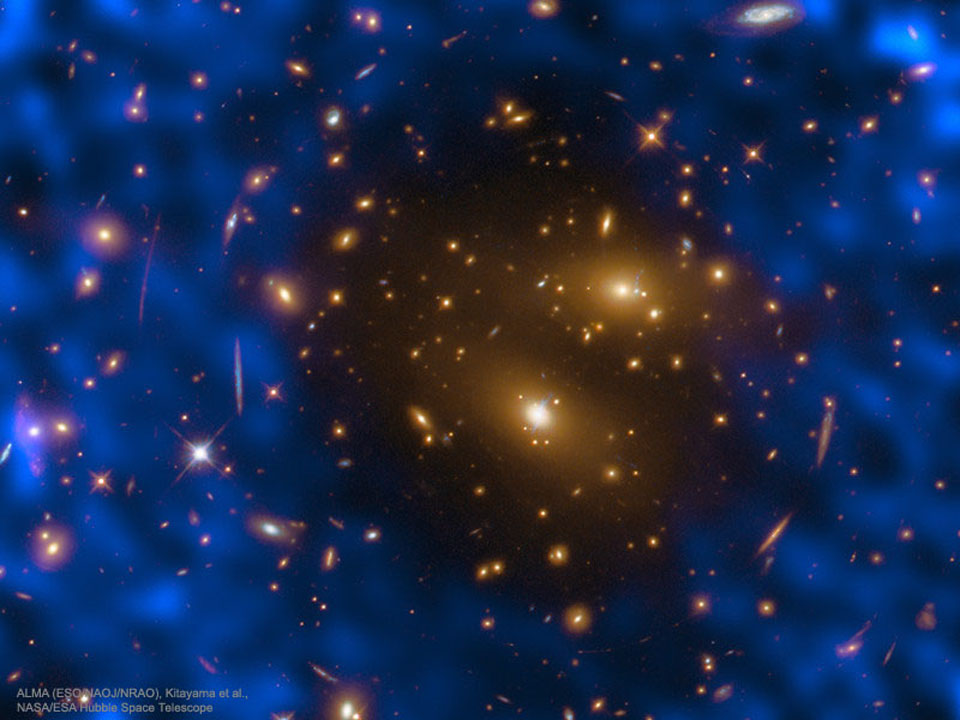
Why would this cluster of galaxy punch a hole in the cosmic microwave background (CMB)? First, the famous CMB was created by cooling gas in the early universe and flies right through most gas and dust in the universe. It is all around us. Large clusters of galaxies have enough gravity to contain very hot gas -- gas hot enough to up-scatter microwave photons into light of significantly higher energy, thereby creating a hole in CMB maps. This Sunyaev�Zel'dovich (SZ) effect has been used for decades to reveal new information about hot gas in clusters and even to help discover galaxy clusters in a simple yet uniform way. Pictured is the most detailed image yet obtained of the SZ effect, now using both ALMA to measure the CMB and the Hubble Space Telescope to measure the galaxies in the massive galaxy cluster RX J1347.5-1145. False-color blue depicts light from the CMB, while almost every yellow object is a galaxy. The shape of the SZ hole indicates not only that hot gas is present in this galaxy cluster, but also that it is distributed in a surprisingly uneven manner.