Galaxy Cluster
Galaxy clusters are the most massive gravitationally bound structures in the Universe, containing hundreds to thousands of galaxies, vast amounts of hot gas, and a dominant component of dark matter. Typical masses range from 10¹⁴ to 10¹⁵ M☉ (solar masses), and sizes span several million light‑years.
These clusters form through hierarchical growth: smaller galaxy groups merge over time to create larger clusters. They are the primary building blocks of the cosmic web and serve as anchors for superclusters.
Most of a cluster’s mass resides in dark matter, inferred from galaxy motions and gravitational lensing. The intracluster medium (ICM) is made of hot plasma at tens of millions of Kelvin, emitting X‑rays observable by telescopes like Chandra and XMM‑Newton.
Galaxy clusters reveal fundamental physics. Fritz Zwicky first inferred dark matter in the 1930s by noting galaxies moved too quickly to be held by visible mass. Detailed X‑ray and lensing studies confirm that visible galaxies make up only ~1%, while ICM is ~9% and dark matter comprises ~90% of cluster mass.
Clusters are cosmological tools. Measurements of their number, mass distribution, and growth trace the nature of dark energy and the evolution of large-scale structure.
They also act as gravitational lenses: their mass bends light from distant galaxies, magnifying and distorting background sources—used to study high-redshift galaxies and map mass distribution.
Galaxy clusters include familiar nearby examples like the Virgo Cluster, Coma Cluster, and the Perseus Cluster. They also host extreme systems such as the Bullet Cluster—where colliding subclusters provide compelling evidence for dark matter—and distant massive clusters located over 10 billion light‑years away.
Modern observatories like Hubble, Chandra, and JWST continue to probe cluster dynamics, star formation, black hole growth, and dark matter profiles within these colossal systems.
Sources
APODs including "Galaxy Cluster"
The Perseus Cluster Waves
4 May 2017
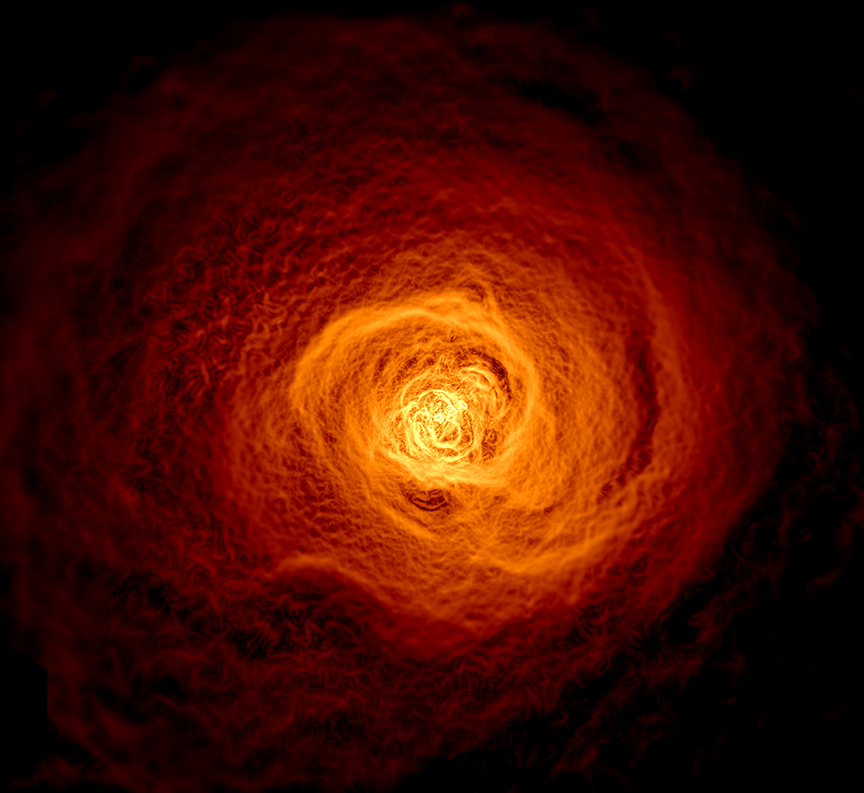
The cosmic swirl and slosh of giant waves in an enormous reservoir of glowing hot gas are traced in this enhanced X-ray image from the Chandra Observatory. The frame spans over 1 million light-years across the center of the nearby Perseus Galaxy Cluster, some 240 million light-years distant. Like other clusters of galaxies, most of the observable mass in the Perseus cluster is in the form of the cluster-filling gas. With temperatures in the tens of millions of degrees, the gas glows brightly in X-rays. Computer simulations can reproduce details of the structures sloshing through the Perseus cluster's X-ray hot gas, including the remarkable concave bay seen below and left of center. About 200,000 light-years across, twice the size of the Milky Way, the bay's formation indicates that Perseus itself was likely grazed by a smaller galaxy cluster billions of years ago.