HiRISE
HiRISE (High Resolution Imaging Science Experiment) is a powerful camera aboard NASA's Mars Reconnaissance Orbiter. It captures high-resolution images of the Martian surface, allowing scientists to observe features as small as a kitchen table, aiding in the selection of landing sites and the study of Mars' geology.
Source: science.nasa.gov
APODs including "HiRISE"
Small Moon Deimos
07/09/2024
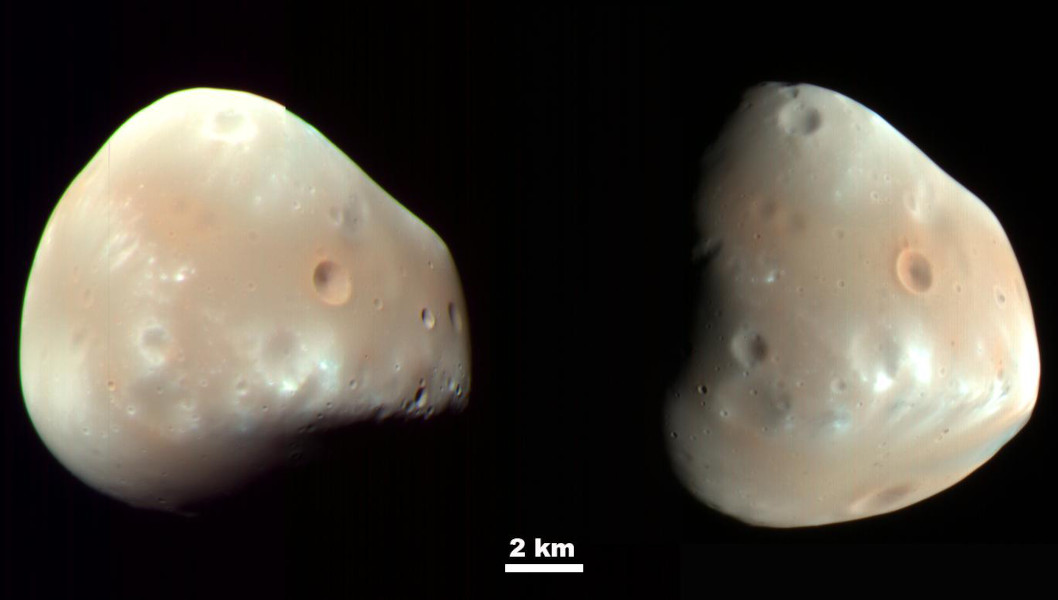
Mars has two tiny moons, Phobos and Deimos, named for the figures in Greek mythology Fear and Panic. Detailed surface views of smaller moon Deimos are shown in both these panels. The images were taken in 2009, by the HiRISE camera on board the Mars Reconnaissance Orbiter spacecraft, NASA's long-lived interplanetary internet satellite. The outermost of the two Martian moons, Deimos is one of the smallest known moons in the Solar System, measuring only about 15 kilometers across. Both Martian moons were discovered in 1877 by Asaph Hall, an American astronomer working at the US Naval Observatory in Washington D.C. But their existence was postulated around 1610 by Johannes Kepler, the astronomer who derived the laws of planetary motion. In this case, Kepler's prediction was not based on scientific principles, but his writings and ideas were so influential that the two Martian moons are discussed in works of fiction such as Jonathan Swift's Gulliver's Travels, written in 1726, over 150 years before their discovery.