Hubble Space Telescope
A space-based observatory launched in 1990 by NASA and ESA, providing high-resolution images of astronomical objects in visible, ultraviolet, and near-infrared light.
Source: nasa.gov
APODs including "Hubble Space Telescope"
Hubble Floats Free Credit:
06/03/1997
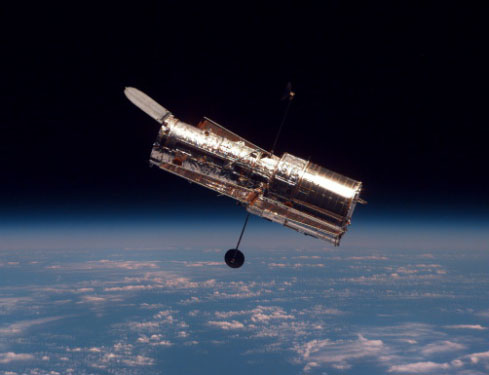
Why put observatories in space? Most telescopes are on the ground. On the ground, you can deploy a heavier telescope and upgrade it more easily. The trouble is that Earth-bound telescopes must look through the Earth's atmosphere. First, the Earth's atmosphere blocks out a broad range of the electromagnetic spectrum, allowing a narrow band of visible light to reach the surface. Telescopes which explore the Universe using light beyond the visible spectrum, such as those onboard the Compton Observatory (gamma rays), the ASCA satellite (x-rays), or the new ultraviolet and infrared instruments on the above-pictured Hubble Space Telescope (HST), need to be carried above the absorbing atmosphere. Second, the Earth's atmosphere blurs the light it lets through. The blurring is caused by varying density and continual motion of air. By orbiting above the Earth's atmosphere, the Hubble can get clearer images. In fact, even though HST has a mirror 15 times smaller than large Earth-bound telescopes, it can still resolve detail almost 100 times finer.