Hubble Space Telescope
A space-based observatory launched in 1990 by NASA and ESA, providing high-resolution images of astronomical objects in visible, ultraviolet, and near-infrared light.
Source: nasa.gov
APODs including "Hubble Space Telescope"
M42: A Mosaic of Orion's Great Nebula
11/05/1997
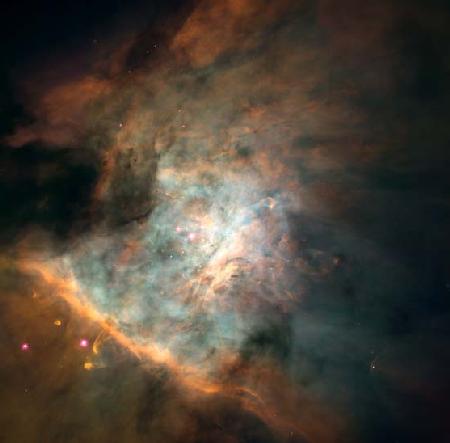
The Great Nebula in Orion, an immense, nearby starbirth region, is probably the most famous of all astronomical nebulae. Here, 15 pictures from the Hubble Space Telescope have been mosaicked to cover the inner 2.5 light years of the nebula and illustrate its diverse nature. In addition to housing a bright open cluster of stars known as the Trapezium, the Orion Nebula contains many stellar nurseries. These nurseries contain hydrogen gas, hot young stars, proplyds, and stellar jets spewing material at high speeds. Most of the filamentary structures visible in this image are actually shock waves - fronts where fast moving material encounters slow moving gas. Shocks are particularly apparent near the bright stars in the lower left of the picture. The Orion Nebula is about 1500 light years distant, located in the same spiral arm of our Galaxy as the Sun.