Hubble Space Telescope
A space-based observatory launched in 1990 by NASA and ESA, providing high-resolution images of astronomical objects in visible, ultraviolet, and near-infrared light.
Source: nasa.gov
APODs including "Hubble Space Telescope"
Jovian Aurora
23/01/1998
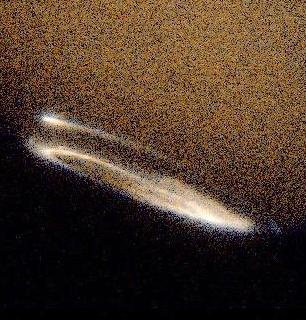
These two recently released Hubble Space Telescope close-ups show the Northern and Southern lights ... on Jupiter. Like aurora on Earth, these Jovian aurora are caused by charged particles funneled into the atmosphere above the planet's North (right) and South poles by magnetic fields. But Jupiter's magnetic field is extremely large and ionized material expelled from the volcanic moon Io is trapped in it creating light shows 1,000 times more intense than Earth's auroral storms. Charged particles released by Io are also funneled along magnetic flux tubes which form a direct "bridge" to the Jovian atmosphere. The result is auroral hot spots - magnetic footprints 600 or more miles across which race over Jupiter's cloud tops. A hot spot is visible in both images as a comet-like feature just outside the polar auroral rings. In these false color ultraviolet images, Jupiter's limb (edge) appears dull brown while the auroral displays are shades of white and blue.