Hubble Space Telescope
A space-based observatory launched in 1990 by NASA and ESA, providing high-resolution images of astronomical objects in visible, ultraviolet, and near-infrared light.
Source: nasa.gov
APODs including "Hubble Space Telescope"
N159 and the Papillon Nebula
14/06/1999
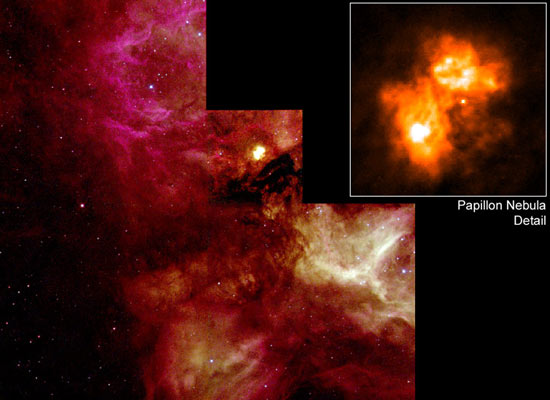
In a search for massive stars, the Hubble Space Telescope has peered into yet another spectacular region of star formation. This nebula, known as N159, spans over 150 light-years and is located in the neighboring Large Magellanic Cloud galaxy, about 170,000 light years distant. Visible in the above picture are bright newborn stars, dark filaments of dust, and red-glowing hydrogen gas. The aptly named Papillon Nebula (French for butterfly), is the unusual central compact cloud, highlighted in the inset. Reasons for the bipolar shape of the Papillon Nebula are currently unknown, but might indicate the presence of unseen high-mass stars and a thick gaseous disk.