Hubble Space Telescope
A space-based observatory launched in 1990 by NASA and ESA, providing high-resolution images of astronomical objects in visible, ultraviolet, and near-infrared light.
Source: nasa.gov
APODs including "Hubble Space Telescope"
Abell 2218: A Galaxy Cluster Lens
07/10/2001
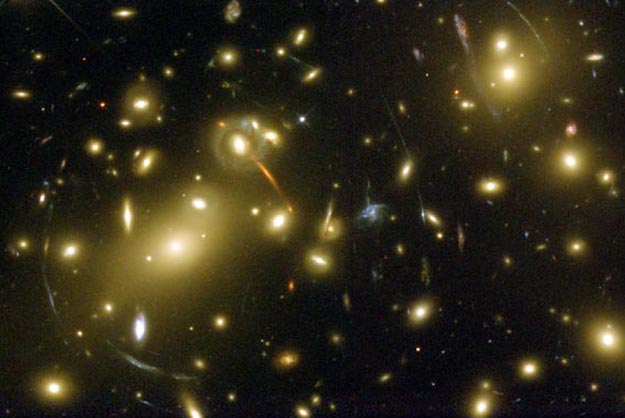
Gravity can bend light, allowing huge clusters of galaxies to act as telescopes. Almost all of the bright objects in this released Hubble Space Telescope image are galaxies in the cluster known as Abell 2218. The cluster is so massive and so compact that its gravity bends and focuses the light from galaxies that lie behind it. As a result, multiple images of these background galaxies are distorted into long faint arcs - a simple lensing effect analogous to viewing distant street lamps through a glass of wine. The cluster of galaxies Abell 2218 is itself about three billion light-years away in the northern constellation Draco. The power of this massive cluster telescope has recently allowed astronomers to detect a galaxy at redshift 5.58, the most distant galaxy yet measured. This young, still-maturing galaxy is faintly visible to the lower right of the cluster core.