Hubble Space Telescope
A space-based observatory launched in 1990 by NASA and ESA, providing high-resolution images of astronomical objects in visible, ultraviolet, and near-infrared light.
Source: nasa.gov
APODs including "Hubble Space Telescope"
N49's Cosmic Blast
06/03/2004
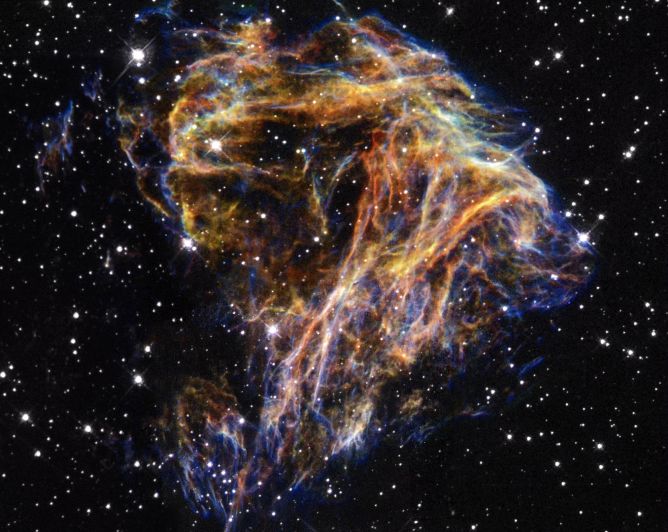
Scattered debris from a cosmic supernova explosion lights up the sky in this gorgeous composited image based on data from the Hubble Space Telescope. Cataloged as N49, these glowing filaments of shocked gas span about 30 light-years in our neighboring galaxy, the Large Magellanic Cloud. Light from the original exploding star reached Earth thousands of years ago, but N49 also marks the location of another energetic outburst -- an extremely intense blast of gamma-rays detected by satellites only twenty-five years ago on March 5, 1979. That date was the beginning of an exciting journey in astrophysics which led researchers to the understanding of an exotic new class of stars. The source of the March 5th Event is now attributed to a magnetar - a highly magnetized, spinning neutron star also born in the ancient stellar explosion which created supernova remnant N49. The magnetar hurtles through the supernova debris cloud at over 1,200 kilometers per second.