Hubble Space Telescope
A space-based observatory launched in 1990 by NASA and ESA, providing high-resolution images of astronomical objects in visible, ultraviolet, and near-infrared light.
Source: nasa.gov
APODs including "Hubble Space Telescope"
Exploring the Antennae
12/02/2015
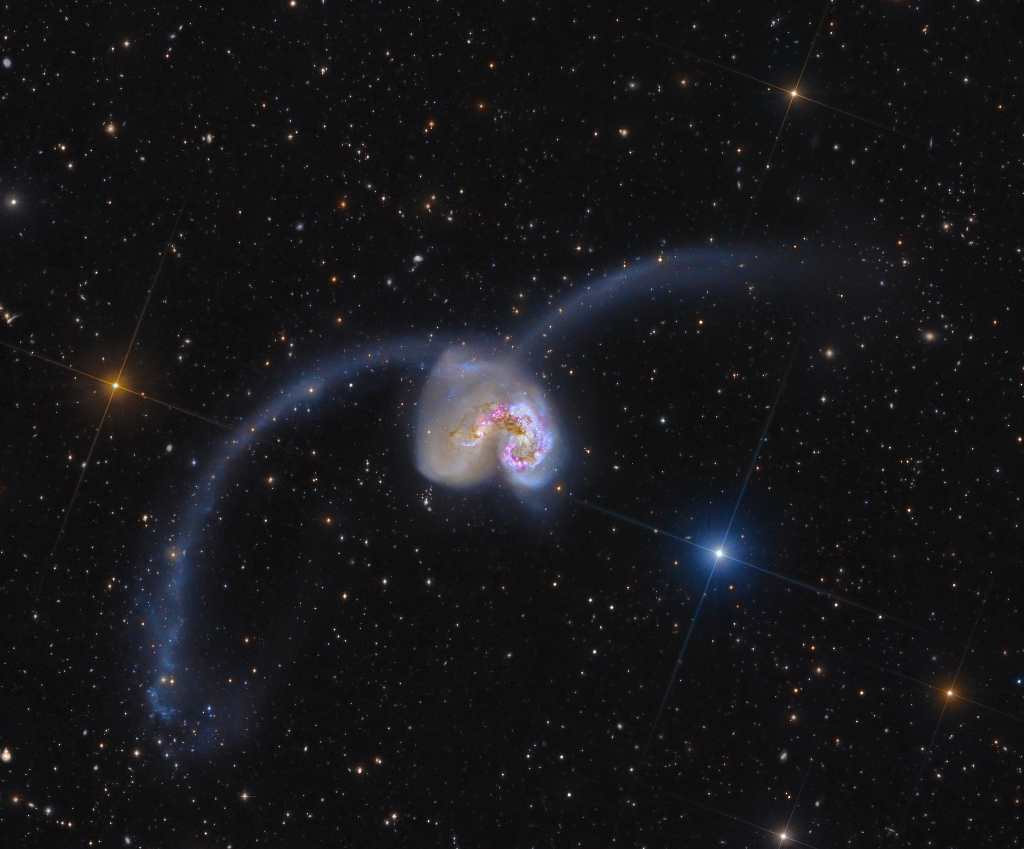
Some 60 million light-years away in the southerly constellation Corvus, two large galaxies are colliding. The stars in the two galaxies, cataloged as NGC 4038 and NGC 4039, very rarely collide in the course of the ponderous cataclysm, lasting hundreds of millions of years. But their large clouds of molecular gas and dust often do, triggering furious episodes of star formation near the center of the cosmic wreckage. Spanning about 500 thousand light-years, this stunning composited view also reveals new star clusters and matter flung far from the scene of the accident by gravitational tidal forces. The remarkable collaborative image is a mosaic constructed using data from small and large ground-based telescopes to bring out large-scale and faint tidal streams, composited with the bright cores imaged in extreme detail by the Hubble Space Telescope. Of course, the suggestive visual appearance of the extended arcing structures gives the galaxy pair its popular name - The Antennae.