Hubble Space Telescope
A space-based observatory launched in 1990 by NASA and ESA, providing high-resolution images of astronomical objects in visible, ultraviolet, and near-infrared light.
Source: nasa.gov
APODs including "Hubble Space Telescope"
The Eagle and The Swan
24/08/2017
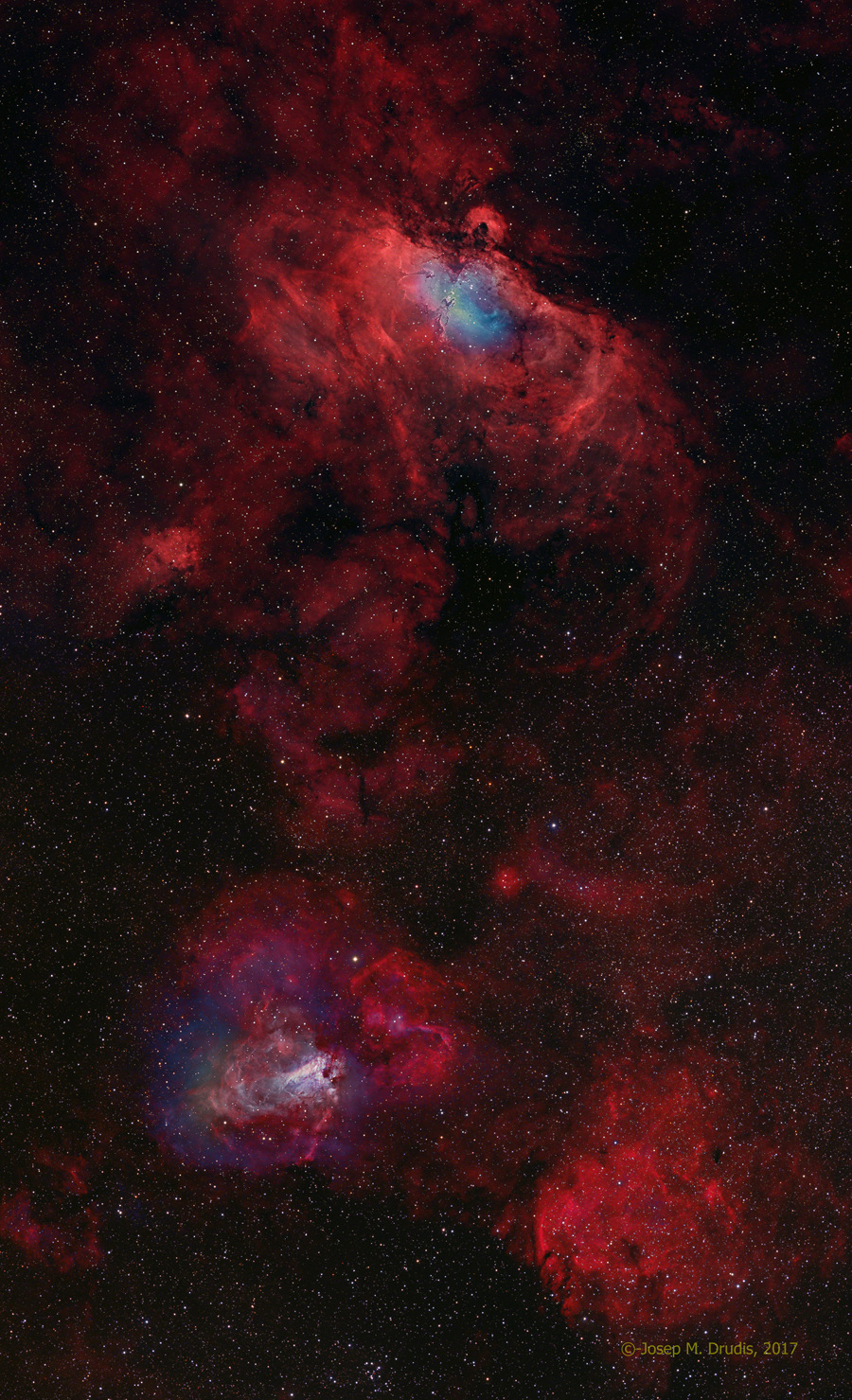
The Eagle Nebula and the Swan Nebula span this broad starscape, a telescopic view toward the Sagittarius spiral arm and the center of our Milky Way galaxy. The Eagle, also known as M16, is at top and M17, the Swan, at bottom of the frame showing the cosmic clouds as brighter regions of active star-formation. They lie along the spiral arm suffused with reddish emission charactistic of atomic hydrogen gas, and dusty dark nebulae. M17, also called the Omega Nebula, is about 5500 light-years away, while M16 is some 6500 light-years distant. The center of both nebulae are locations of well-known close-up images of star formation from the Hubble Space Telescope. In this mosaic image that extends about 3 degrees across the sky, narrowband, high-resultion image data has been used to enhance the central regions of the Eagle and Swan. The extended wings of the Eagle Nebula spread almost 120 light-years. The Swan is over 30 light-years across.