Hubble Space Telescope
A space-based observatory launched in 1990 by NASA and ESA, providing high-resolution images of astronomical objects in visible, ultraviolet, and near-infrared light.
Source: nasa.gov
APODs including "Hubble Space Telescope"
HH 666: Carina Dust Pillar with Jet
14/12/2021
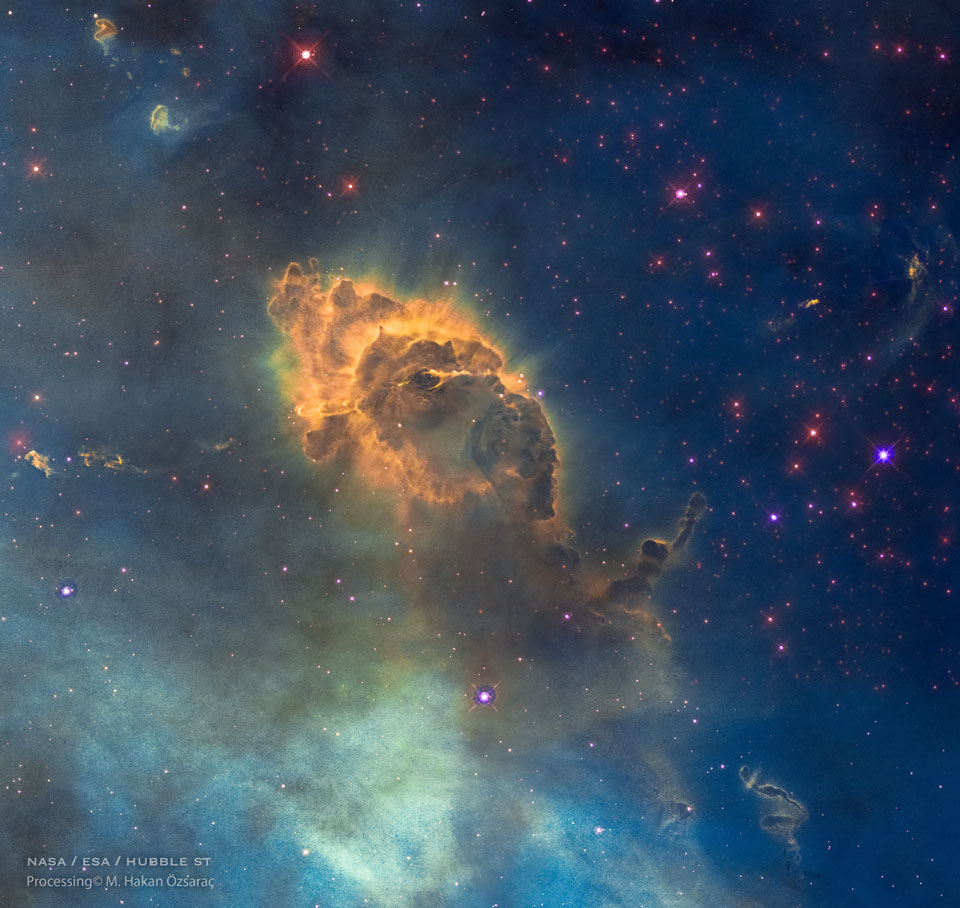
To some, it may look like a beehive. In reality, the featured image from the Hubble Space Telescope captures a cosmic pillar of dust, over two-light years long, inside of which is Herbig-Haro 666 -- a young star emitting powerful jets. The structure lies within one of our galaxy's largest star forming regions, the Carina Nebula, shining in southern skies at a distance of about 7,500 light-years. The pillar's layered outline are shaped by the winds and radiation of Carina's young, hot, massive stars, some of which are still forming inside the nebula. A dust-penetrating view in infrared light better shows the two, narrow, energetic jets blasting outward from a still hidden infant star. Open Science: Browse 2,600+ codes in the Astrophysics Source Code Library