Hubble Space Telescope
A space-based observatory launched in 1990 by NASA and ESA, providing high-resolution images of astronomical objects in visible, ultraviolet, and near-infrared light.
Source: nasa.gov
APODs including "Hubble Space Telescope"
Interstellar Comet 2I Borisov
05/03/2022
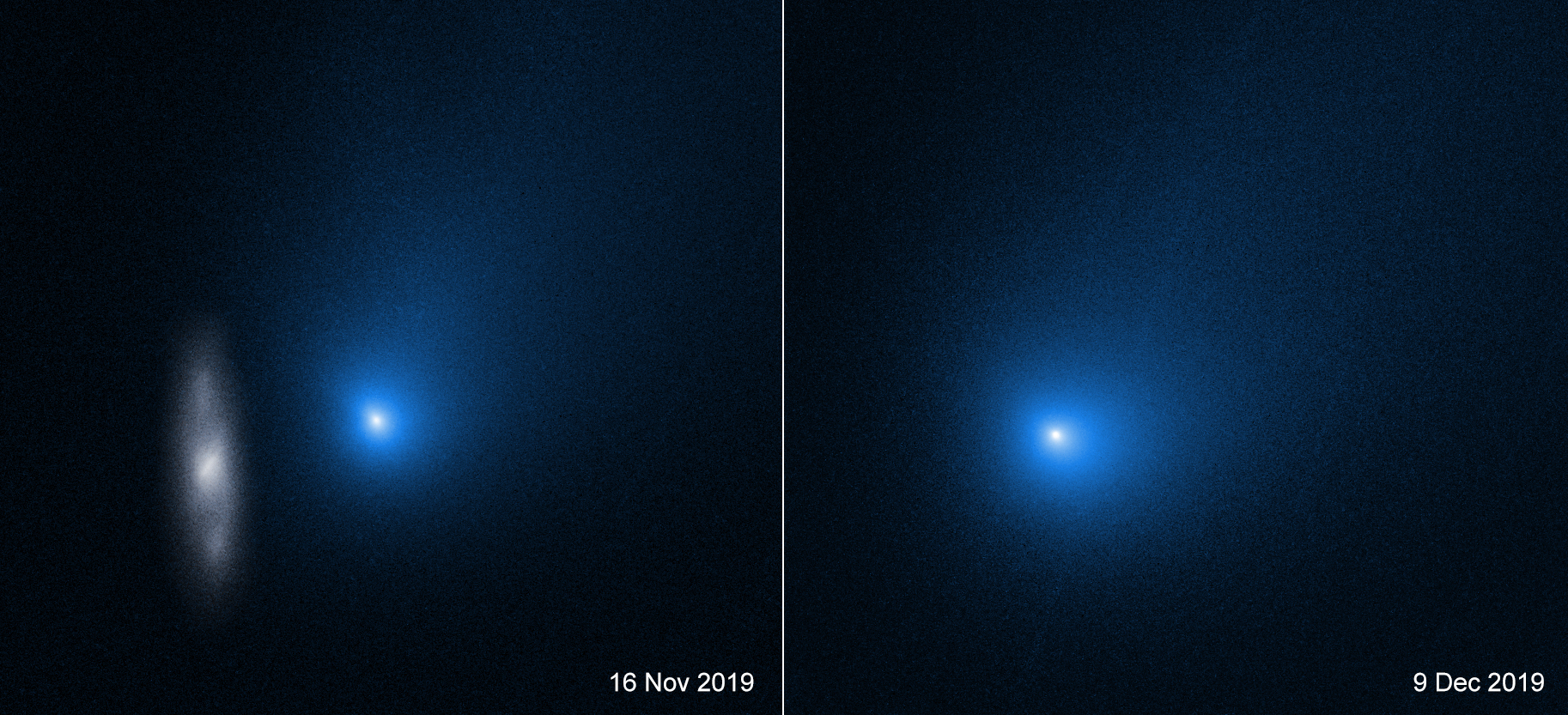
From somewhere else in the Milky Way galaxy, Comet 2I/Borisov was just visiting the Solar System. Discovered by amateur astronomer Gennady Borisov on August 30, 2019, the first known interstellar comet is seen in these two Hubble Space Telescope images from November and December 2019. On the left, a distant background galaxy near the line-of-sight to Borisov is blurred as Hubble tracked the speeding comet and dust tail about 327 million kilometers from Earth. At right, 2I/Borisov appears shortly after perihelion, its closest approach to Sun. European Southern Observatory observations indicate that this comet may never have passed close to any star before its 2019 perihelion passage. Borisov's closest approach to our fair planet, a distance of about 290 million kilometers, came on December 28, 2019. Even though Hubble's sharp images don't resolve the comet's nucleus, they did lead to estimates of less than 1 kilometer for its diameter.