Hubble Space Telescope
A space-based observatory launched in 1990 by NASA and ESA, providing high-resolution images of astronomical objects in visible, ultraviolet, and near-infrared light.
Source: nasa.gov
APODs including "Hubble Space Telescope"
Milky Way Galaxy Doomed: Collision with Andromeda Pending
06/06/2022
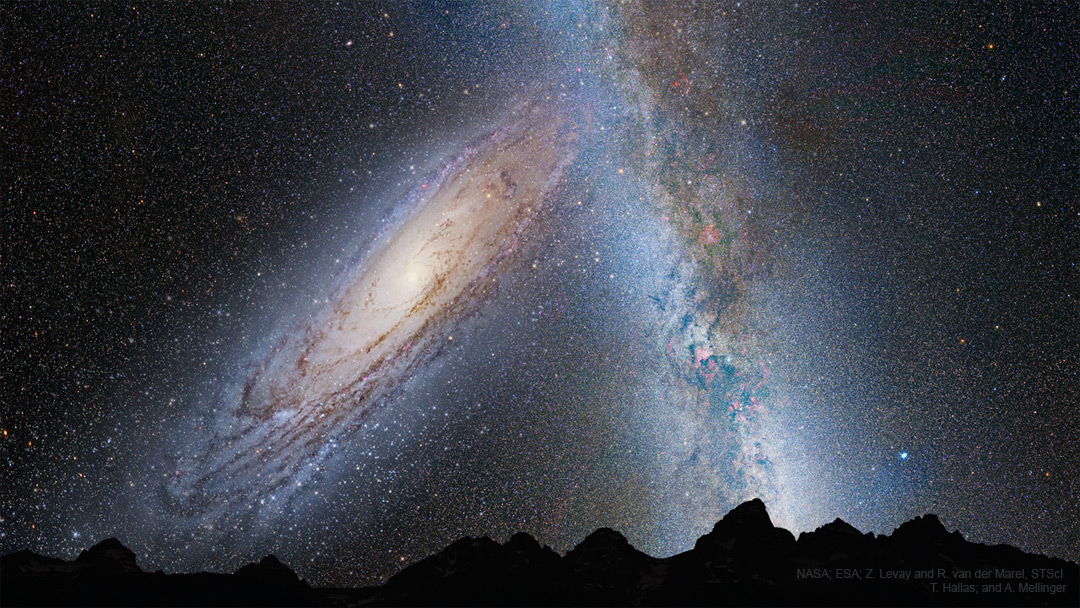
Will our Milky Way Galaxy collide one day with its larger neighbor, the Andromeda Galaxy? Most likely, yes. Careful plotting of slight displacements of M31's stars relative to background galaxies on recent Hubble Space Telescope images indicate that the center of M31 could be on a direct collision course with the center of our home galaxy. Still, the errors in sideways velocity appear sufficiently large to admit a good chance that the central parts of the two galaxies will miss, slightly, but will become close enough for their outer halos to become gravitationally entangled. Once that happens, the two galaxies will become bound, dance around, and eventually merge to become one large elliptical galaxy -- over the next few billion years. Pictured here is a combination of images depicting the sky of a world (Earth?) in the distant future when the outer parts of each galaxy begin to collide. The exact future of our Milky Way and the entire surrounding Local Group of Galaxies is likely to remain an active topic of research for years to come.