Hubble Space Telescope
The Hubble Space Telescope (HST) is a joint NASA and ESA observatory launched on April 24, 1990, aboard the Space Shuttle Discovery (STS‑31). Positioned in low Earth orbit at about 547 kilometers altitude, Hubble avoids atmospheric distortion and captures high-resolution observations in ultraviolet, visible, and near-infrared light.
Named after American astronomer Edwin Hubble, the telescope was inspired by Lyman Spitzer’s 1946 proposal to place telescopes in space. Hubble features a 2.4-meter primary mirror and a suite of scientific instruments designed to be upgraded during space servicing missions.
Soon after deployment, a flaw was discovered in the shape of its primary mirror, which was corrected by astronauts during the first servicing mission in 1993. Over its lifetime, Hubble received five servicing missions, which not only fixed technical issues but also significantly upgraded its capabilities.
Hubble has transformed our understanding of the universe. It helped determine the age of the universe (~13.8 billion years), provided evidence for the acceleration of cosmic expansion due to dark energy, revealed the presence of supermassive black holes in galaxies, and observed planets outside our solar system.
Iconic images captured by Hubble—such as the Pillars of Creation and the Hubble Deep Field—have expanded public engagement with space and allowed astronomers to peer billions of years into the past, studying galaxy formation and cosmic evolution.
Now operating alongside the James Webb Space Telescope, Hubble continues to provide critical observations despite aging hardware, including issues with gyroscopes. Its contributions to astronomy remain unparalleled, offering a legacy of scientific discovery and technological achievement.
Sources
APODs including "Hubble Space Telescope"
Eagle Nebula Pillars in Infrared from Hubble
31 May 2026
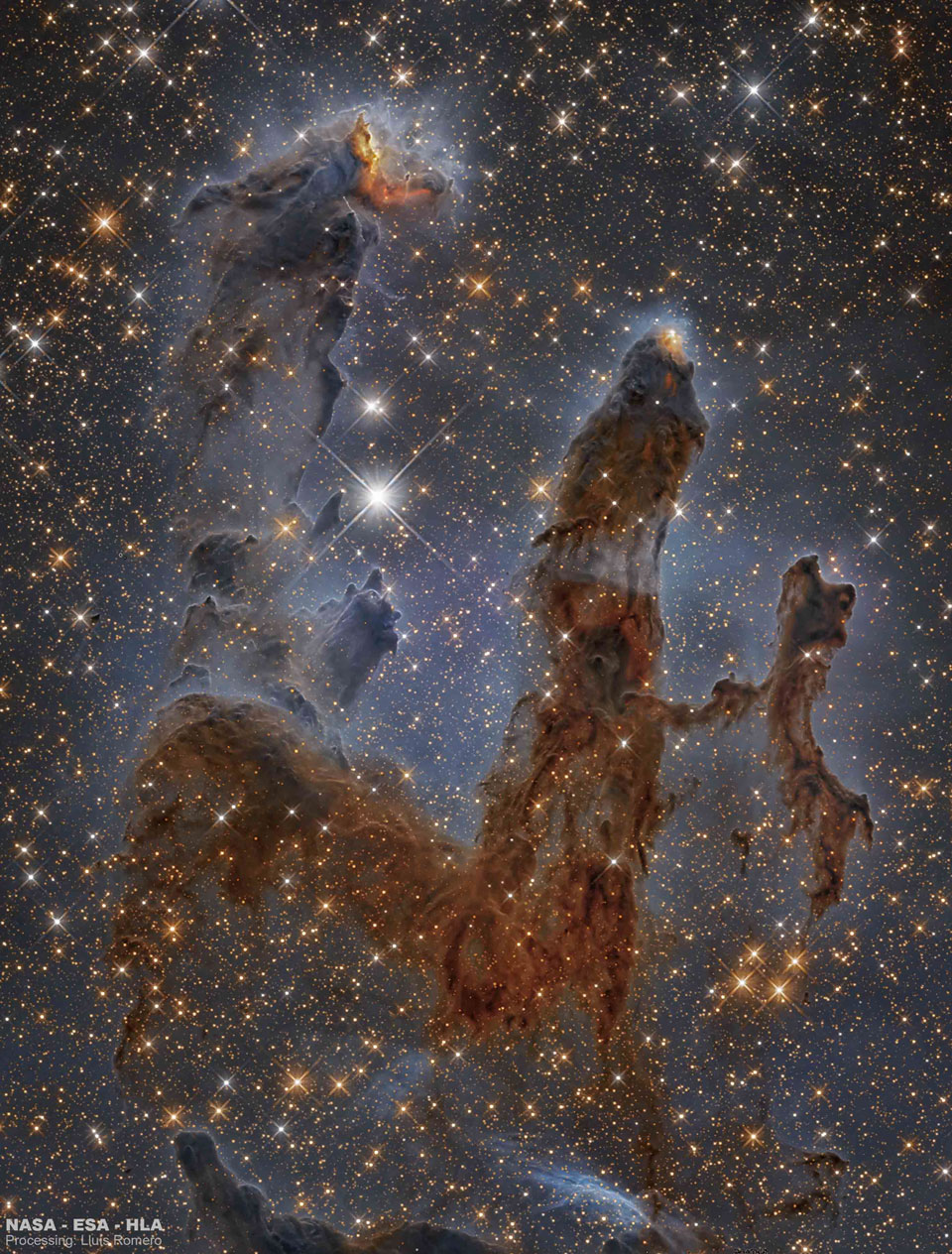
Newborn stars are forming in the Eagle Nebula. They are gravitationally contracting in pillars of dense gas and dust. The intense radiation of these newly-formed bright stars is causing surrounding material to boil away. This image, taken with the Hubble Space Telescope in near infrared light, allows the viewer to see through much of the thick dust that makes the pillars opaque in visible light. The giant structures are light years in length and dubbed informally the Pillars of Creation. Associated with the open star cluster M16, the Eagle Nebula lies about 6,500 light years away. The Eagle Nebula is a satisfying target for small telescopes in a nebula-rich part of the sky toward the split constellation Serpens Cauda (the tail of the snake). Sky Surprise: What picture did APOD feature on your birthday? (after 1995)