IC 1396
IC 1396 is a large emission nebula and star-forming region located about 2,400 light-years away in the constellation Cepheus. Spanning over 3 degrees in the sky, it is illuminated by a hot, massive O-type star near its center and contains several dark globules, including the Elephant's Trunk Nebula.
Source: noirlab.edu
APODs including "IC 1396"
IC 1396 H-Alpha Close-Up
30/09/2005
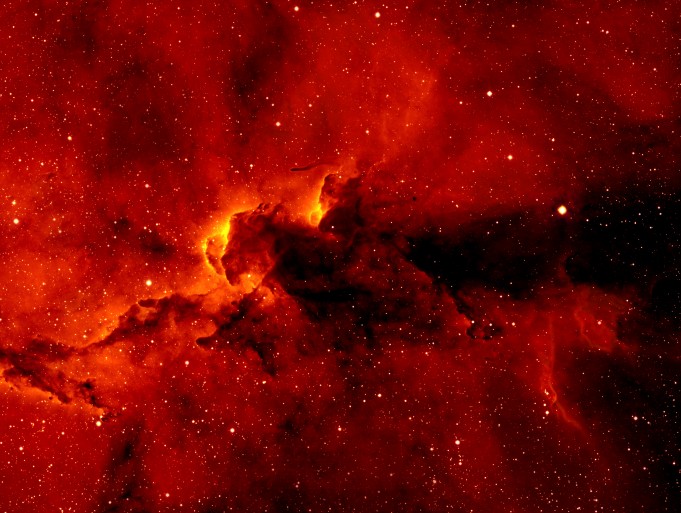
Clouds of glowing hydrogen gas mingle ominously with dark dust lanes in this close-up of IC 1396, an active star forming region some 2,000 light years away in the constellation Cepheus. In this and other similar emission nebulae, energetic ultraviolet light from a hot young star strips electrons from the surrounding hydrogen atoms. As the electrons and atoms recombine they emit longer wavelength, lower energy light in a well known characteristic pattern of bright spectral lines. At visible wavelengths, the strongest emission line in this pattern is in the red part of the spectrum and is known as "Hydrogen-alpha" or just H-alpha. Part of IPHAS, a survey of H-alpha emission in our Milky Way Galaxy, this image spans about 20 light-years and highlights bright, dense regions within IC 1396, likely sites where massive new stars are born.