International Space Station
The International Space Station (ISS) is a modular space laboratory in low Earth orbit, jointly operated by NASA, Roscosmos, ESA, JAXA, and CSA. Launched beginning in 1998, it has been continuously inhabited since November 2000 and supports cutting-edge research in microgravity, Earth observation, and space technology, while fostering international cooperation.
Source: nasa.gov
APODs including "International Space Station"
Atlantis Approaches Mir
02/04/1996
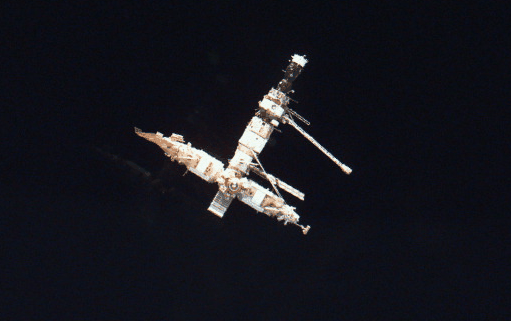
Imagine flying though space and approaching the Mir space station. The crew of the Space Shuttle Atlantis did just this in a mission that ended only two days ago. Mir, now 10 years old, is equipped for scientific experiments in astronomy, physics, materials, biology and chemistry. The top most module on Mir is an unmanned supply ship used to send food and supplies. The next module with the long boom carries telescopes and essential flight equipment and connects to the core module with living quarters and solar panels. To the left is the Spektr module carrying solar arrays and scientific equipment while on the right is a scientific module that also carries an airlock. The docking module seen at the bottom is the ultimate destination of Atlantis. The STS-76 mission left astronaut Shannon Lucid for a planned five month stay. Four more shuttle flights are currently planned to Mir, keeping a NASA astronaut continuously in space until late 1997. In late 1997, building on this jointly developed understanding and experience, the US and Russia will launch the first modules of the International Space Station. Latest Comet Hyakutake images: APOD Hyakutake Archive, JPL, Fayetteville Observer-Times, NASA's Night of the Comet, ICSTARS, Jerry Lodriguss, ScienceWeb, Crni Vrh Obs., Cent. Mich. U.