International Space Station
The International Space Station (ISS) is a modular space laboratory in low Earth orbit, jointly operated by NASA, Roscosmos, ESA, JAXA, and CSA. Launched beginning in 1998, it has been continuously inhabited since November 2000 and supports cutting-edge research in microgravity, Earth observation, and space technology, while fostering international cooperation.
Source: nasa.gov
APODs including "International Space Station"
Mir Above
03/07/1998
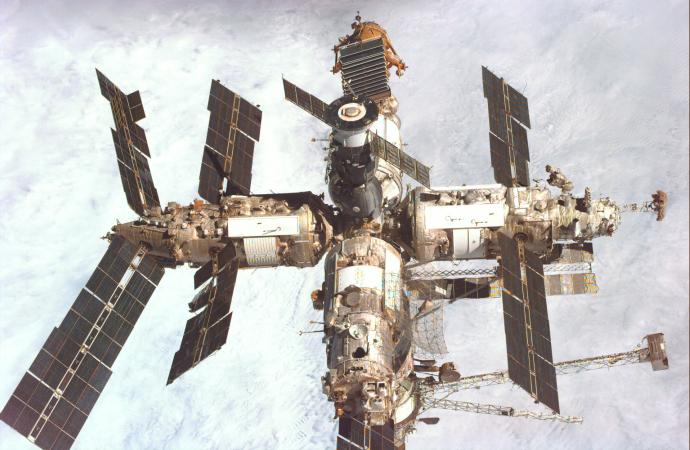
Photographed from the approaching Space Shuttle Endeavour, the Mir space station floats above the clouds of planet Earth. Mir's modular construction, bristling with solar panels and antennas, lends it a slightly whimsical, insect-like appearance. Astronaut Andrew Thomas was dropped off at Mir by Endeavour in January and recently picked up by the Space Shuttle Discovery during STS-91, the ninth and last Mir docking mission. Thomas' 4 1/2 month stay culminates the shuttle-Mir program in which seven U.S. astronauts spent a total of 977 days with Russian crews on board Mir. The experience gained will be applied toward the construction of the International Space Station scheduled to begin with launches in November and December 1998.