International Space Station
The International Space Station (ISS) is a modular space laboratory in low Earth orbit, jointly operated by NASA, Roscosmos, ESA, JAXA, and CSA. Launched beginning in 1998, it has been continuously inhabited since November 2000 and supports cutting-edge research in microgravity, Earth observation, and space technology, while fostering international cooperation.
Source: nasa.gov
APODs including "International Space Station"
Space Shuttle Lifts Off for Space Station
23/04/2001
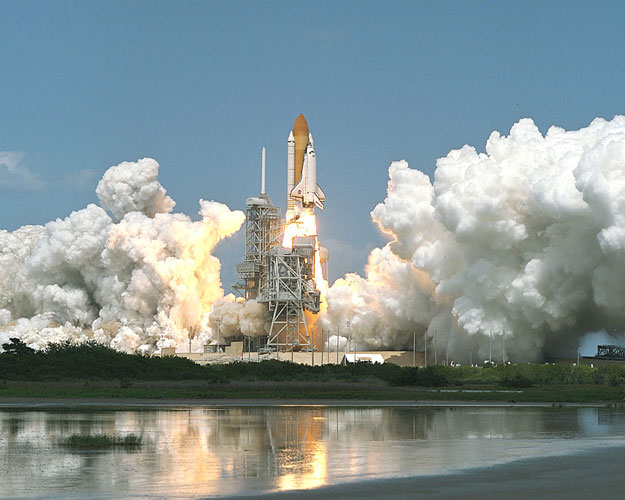
Last Thursday, Space Shuttle Endeavor lifted off on course for the latest round of building the International Space Station (ISS) in orbit around Earth. One of the highlights of the 11-day mission promises to be the installation of Canadarm2, a robotic arm that will assist in the future construction and utilization of the ISS. Canadarm2, a larger and more sophisticated version of the shuttle's own robotic arm, will be able to move around the station's exterior. This is the ninth shuttle mission to build the ISS -- many more are planned over the next several years. When completed, the ISS should enclose about the same room as the passenger cabin of a 747 jet.