International Space Station
The International Space Station (ISS) is a modular space laboratory in low Earth orbit, jointly operated by NASA, Roscosmos, ESA, JAXA, and CSA. Launched beginning in 1998, it has been continuously inhabited since November 2000 and supports cutting-edge research in microgravity, Earth observation, and space technology, while fostering international cooperation.
Source: nasa.gov
APODs including "International Space Station"
Beefing Up the International Space Station
17/12/2002
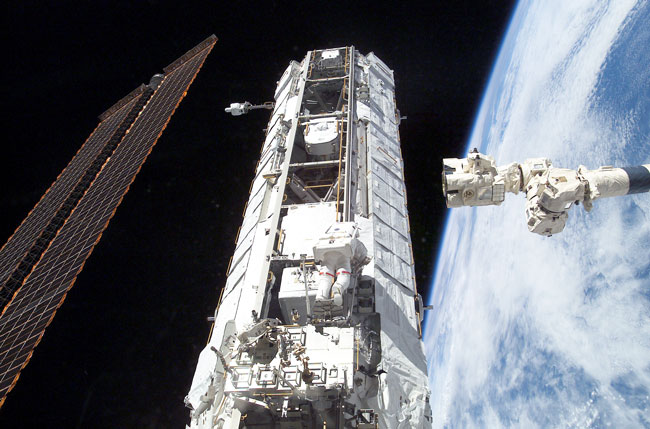
The International Space Station (ISS) will be the largest human-made object ever to orbit the Earth. The station is so large that it could not be launched all at once -- it is being built piecemeal with large sections added continually by flights of the Space Shuttle. To function, the ISS needs trusses to keep it rigid and to route electricity and liquid coolants. These trusses are huge, extending over 15 meters long, and with masses over 10,000 kilograms. Pictured above at the end of last month, astronaut Michael Lopez-Alegria works to install the Port-One Truss. On the right is the end of Canadarm2, the robotic remote control arm of the ISS.