International Space Station
The International Space Station (ISS) is a modular space laboratory in low Earth orbit, jointly operated by NASA, Roscosmos, ESA, JAXA, and CSA. Launched beginning in 1998, it has been continuously inhabited since November 2000 and supports cutting-edge research in microgravity, Earth observation, and space technology, while fostering international cooperation.
Source: nasa.gov
APODs including "International Space Station"
Rollout of Soyuz TMA-2 Aboard an R7 Rocket
09/10/2005
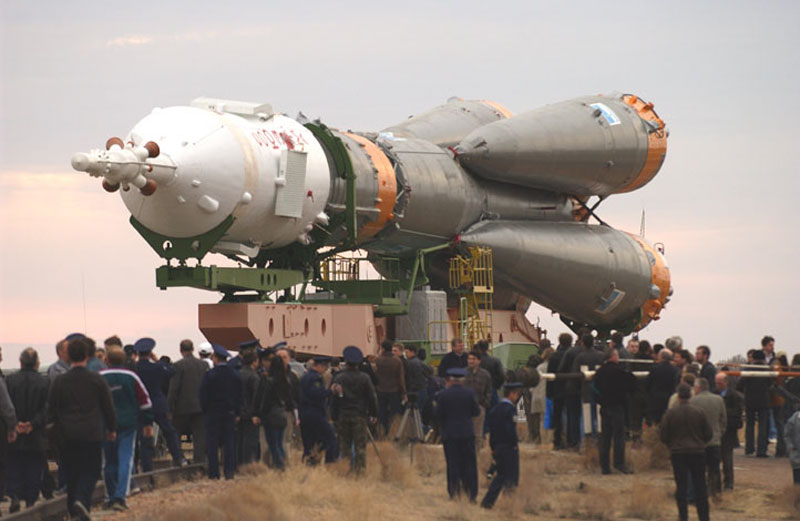
It takes a big rocket to go into space. In 2003 April, this huge Russian rocket was launched toward Earth-orbiting International Space Station (ISS), carrying two astronauts who will make up the new Expedition 7 crew. Seen here during rollout at the Baikonur Cosmodrome, the rocket's white top is actually the Soyuz TMA-2, the most recent version of the longest serving type of human spacecraft. The base is a Russian R7 rocket, originally developed as a prototype Intercontinental Ballistic Missile in 1957. The rocket spans the width of a football field and has a fueled mass of about half a million kilograms. Russian rockets like this remain a primary transportation system to the International Space Station (ISS). Last week, a similar rocket successfully launched a spaceflight participant and two Expedition 12 astronauts to the space station.