International Space Station
The International Space Station (ISS) is a modular space laboratory in low Earth orbit, jointly operated by NASA, Roscosmos, ESA, JAXA, and CSA. Launched beginning in 1998, it has been continuously inhabited since November 2000 and supports cutting-edge research in microgravity, Earth observation, and space technology, while fostering international cooperation.
Source: nasa.gov
APODs including "International Space Station"
Maneuvering in Space
22/05/2006
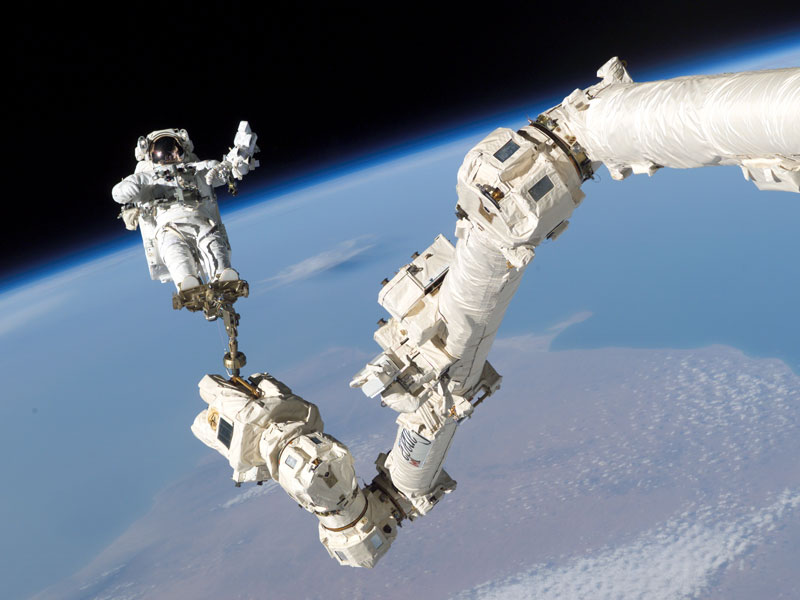
What arm is 17 meters long and sometimes uses humans for fingers? The Canadarm2 aboard the International Space Station (ISS). Canadarm2 has multiple joints and is capable of maneuvering payloads as massive as 116,000 kilograms, equivalent to a fully loaded bus. Canadarm2 is operated by remote control by a human inside the space station. To help with tasks requiring a particularly high level of precision and detail, an astronaut can be anchored to an attached foot constraint. The arm is able propel itself end-over-end around the outside of the space station. Pictured above, astronaut Stephen Robinson rides Canadarm2 during the STS-114 mission of the space shuttle Discovery to the ISS in 2005 August. Space shuttles often deploy their own original version of a robotic arm dubbed Canadarm. Next year, a second robotic arm is scheduled to be deployed on the space station.